Opening: This Chair is Silently Determining Your EBITDA and Legal Budget
Before you approve the next large office furniture procurement budget, please move this document from the “Administrative Procurement” folder to the “Strategic Investment and Risk Management” filing cabinet. What you are about to sign is not a simple furniture order, but a strategic decision document that may profoundly affect the company’s talent density, operational efficiency, and even future litigation risks.
Traditional procurement plans talk about cost and comfort, but this guide will directly reveal: how a chair can become a lever to drive productivity growth, and how it can degenerate into a “Trojan horse” that erodes profits and triggers legal disputes.
I. Risk Due Diligence: The “Contingent Liabilities” Hidden in the Shadow of “Cost Control”
For an excellent organization, unidentified risks are the biggest cost. Let’s start with the risk exposures that most concern CFOs and Legal Directors.
| Risk Dimension | Risk Details (Real Pain Points of B2B Clients) | Authoritative Data & Legal Perspective |
|---|---|---|
| Legal Litigation & Compliance Risks | “Musculoskeletal Disorders (MSDs)” are not only the world’s number one occupational disease, but also a ticking time bomb in the company’s “contingent liabilities”. When employees can legally trace their lumbar injuries, carpal tunnel syndrome and other problems to the non-compliant office equipment provided by the company, you will face an average of **$15,000 to $35,000 in direct compensation per case**, as well as the subsequent soaring insurance rates and immeasurable loss of brand reputation. | According to the latest data from the **National Safety Council (NSC)**, the per-case cost of compensation for work-related overwork and repetitive strain injuries (including MSDs) continues to rise. The **Occupational Safety and Health Administration (OSHA)**’s “General Duty Clause” clearly requires employers to provide a “workplace free from recognized hazards”. Purchasing substandard chairs is itself a **”foreseeable compliance breach”**. |
| Core Talent Asset Attrition | In the “war for elite talent”, the office environment is the most silent but also the most eloquent “employer statement” besides salary and benefits. Top engineers, designers, and analysts have bodies that are their highest-value “production tools”. When they are forced to “struggle” with a cheap chair that cannot support their high-intensity mental work every day, what they feel is not frugality, but **”disregard for personal value”**. **The cost of talent attrition (recruitment, training, opportunity cost) is more than 100 times the price of a chair.** | Surveys by **Gallup** consistently show a strong correlation between employee engagement and the physical work environment. Furthermore, **Harvard Business Review** points out that top talents will take the initiative to “vote with their feet” and choose companies that truly invest in “people” themselves. Cheap chairs are silently filtering out the people you most want to retain. |
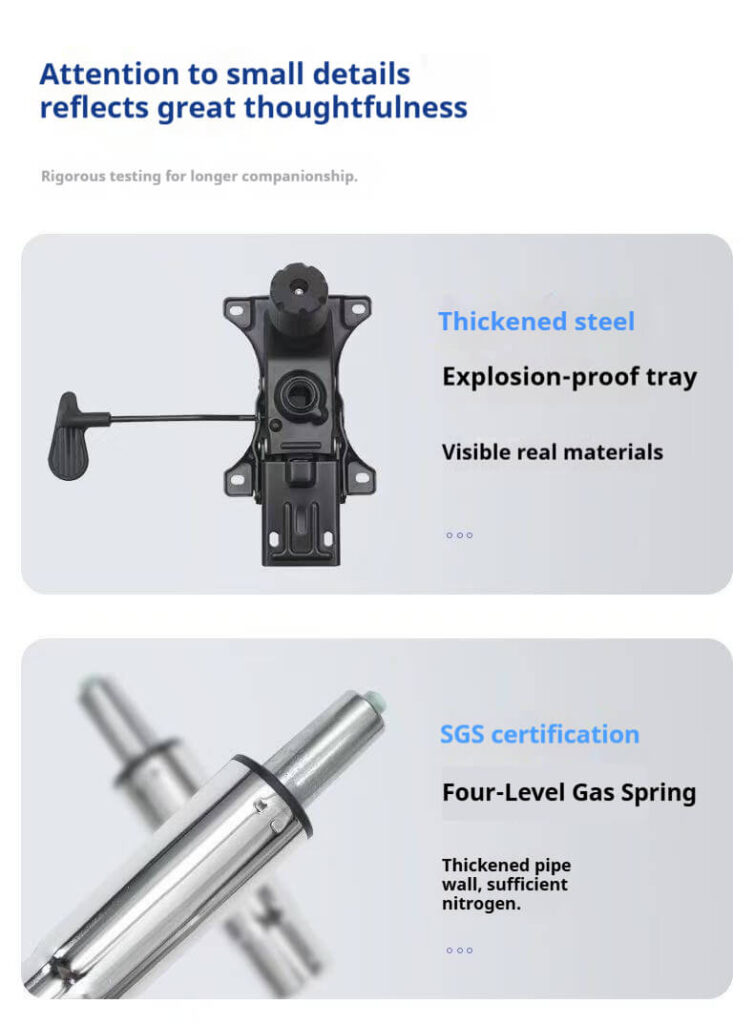
| Out-of-Control “Total Cost of Ownership (TCO)” | The “procurement price” advantage of cheap chairs is a complete financial trap. Their **”lifecycle cost”** is extremely high: short warranty period, fragile and potentially dangerous gas lifts (posing direct safety accident risks), and non-modular replacement parts mean you will be forced to carry out **”destructive scrapping” and “repetitive investment”** within 2-3 years. Behind this are continuous hidden operational expenses (OpEx) for administration, logistics, installation, and waste disposal. | The X5.1 test standard of **BIFMA (Business and Institutional Furniture Manufacturers Association)** simulates **10+ years** of commercial use intensity. For example, its “gas lift impact test” requires dropping heavy objects from a height to ensure safety in extreme cases. Chairs without this certification have a TCO that is an unpredictable, continuously bleeding financial statement. |
II. Quantitative Value Assessment: How to Classify a Chair as a “Strategic Asset”
Only after avoiding liabilities can we discuss how to transform this investment into a quantifiable, reportable “high-quality asset”.
| Value Dimension | Value Details (B2B Client Benefits) | Financial & Strategic Perspective |
|---|---|---|
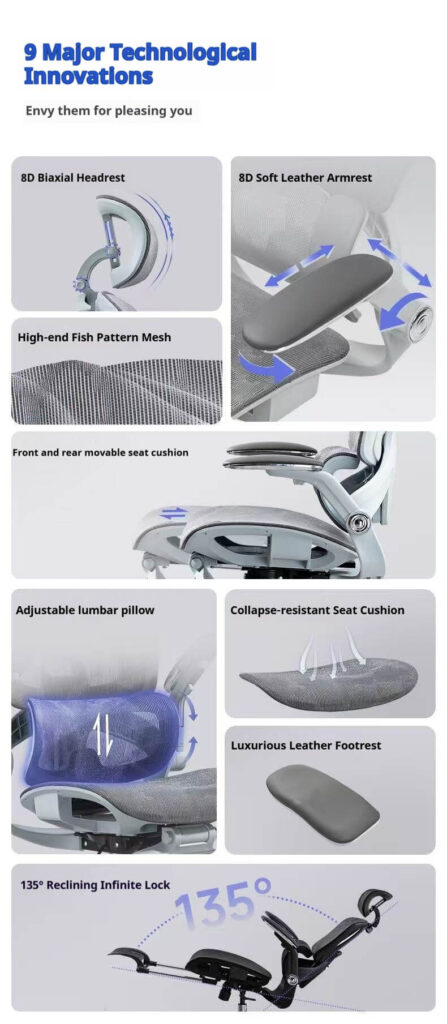
| Building a “Litigation-Free” Legal Moat | Purchasing and documenting professional ergonomic chairs that meet BIFMA standards and have complete adjustment functions is a key link in building an **”active defense”** system at the legal level. It proves to regulators and potential litigants that the company has fulfilled its **”Duty of Care”** to provide a safe and healthy work environment. This investment essentially converts uncontrollable litigation risks into a **controllable, capitalizable fixed asset**. | From a financial perspective, this is a **”risk capitalization”** operation. It hedges and eliminates potential, huge litigation losses through a fixed, predictable capital expenditure (CapEx). This is the most robust risk management method in the eyes of a CFO. |
| Improving Profit Margin of “Cognitive Output” | The real value addition lies in **freeing employees from “physical internal friction” to achieve 100% focus on “cognitive resources”**. A poor chair will continuously distract employees through discomfort, making it impossible for them to enter a highly efficient “flow state”. An excellent ergonomic chair, however, can make the employee’s body “invisible”, allowing all their intellectual resources to be used for **high-value activities that directly create profits**, such as coding, creative thinking, and financial analysis. | According to research from the **Cornell University Ergonomics Laboratory**, an optimized ergonomic environment can increase employee **work efficiency by up to 17%**. You can directly apply this percentage to the team’s salary costs to calculate a clear **”productivity value-added ROI”**. |
| Consolidating Intangible Assets of “Employer Brand” | Every chair in the office is a “physical billboard” for your corporate culture. In the eyes of top venture capitalists, key clients, and scarce talents, a Herman Miller or Humanscale-level chair conveys a message far beyond any gorgeous words on a PPT. It represents **”We invest in our most core asset — our people”**. This brand perception will ultimately be reflected in **lower financing costs, higher customer trust, and stronger talent attractiveness**. | In brand strategy, this is called **”Physical Evidence”**. It transforms abstract corporate values into tangible, perceptible physical reality, and is the most solid step in building a high-end, trustworthy employer brand. |
III. C-Suite Exclusive FAQ — Prepared for the Highest Decision-Makers
Q: The Finance Department questions: How to prove that an 8,000-yuan chair is more “cost-effective” financially than an 800-yuan one?
A: Submit a “10-Year TCO and Strategic Value Analysis Report of Office Chairs” and abandon the “unit price” comparison. Core formula: Net Present Value (NPV) = ∑ [ (Annual Efficiency Improvement Benefits + Talent Attrition Reduction Benefits) – Annual Operating Costs ] / (1 + Discount Rate)^n – Total Initial Investment**. At the same time, attach a “Legal Risk Exposure Comparative Analysis” to prove with data that short-term high investment is to avoid long-term, uncontrollable huge financial and legal risks.
Q: The Legal Department is concerned: Is purchasing only BIFMA-certified products sufficient for “immunity” in law?
A: This is the most critical but not the only link in establishing an evidence chain of “Duty of Care”. Purchasing BIFMA-certified products proves the company’s professionalism in “tool selection”. You also need to cooperate with **ergonomic training for employees and establish a rapid response mechanism for equipment issues** to form a complete risk management closed loop. BIFMA is your “shield”, but proactive management actions are your “armor”.
Q: The HR Director asks: Faced with employees in different positions and body types, how to achieve a balance between “fairness” and “efficiency”?
A: Adopt an **”agile procurement strategy”** instead of a “one-size-fits-all” approach. Establish a **”Preferred Supplier List (PSL)”** containing 2-3 flagship models, all of which must have an extremely wide adjustment range (such as 4D armrests, adjustable seat depth, dynamic lumbar support) that can cover 5% to 95% of human body size percentiles. Authorize employees to choose according to their personal trial experience within the budget. This reflects “people-oriented” while minimizing management costs.
The Final Decision Point (The Final Hook)
Every day, your employees entrust their most valuable assets — **creativity and health** — to the company for up to 8 hours.
And the chair they sit on is **increasing or depreciating** this core asset day by day, in a “compound interest” manner.
This decision will ultimately be reflected in your financial statements. Do you choose to invest in “assets” or pay for future “liabilities”?
Before you make the final decision, do you need a “Strategic Value PPT Template for Ergonomic Investment” designed specifically for board presentations? Contact us to make every penny of your investment an unassailable, growth-driven strategic investment.