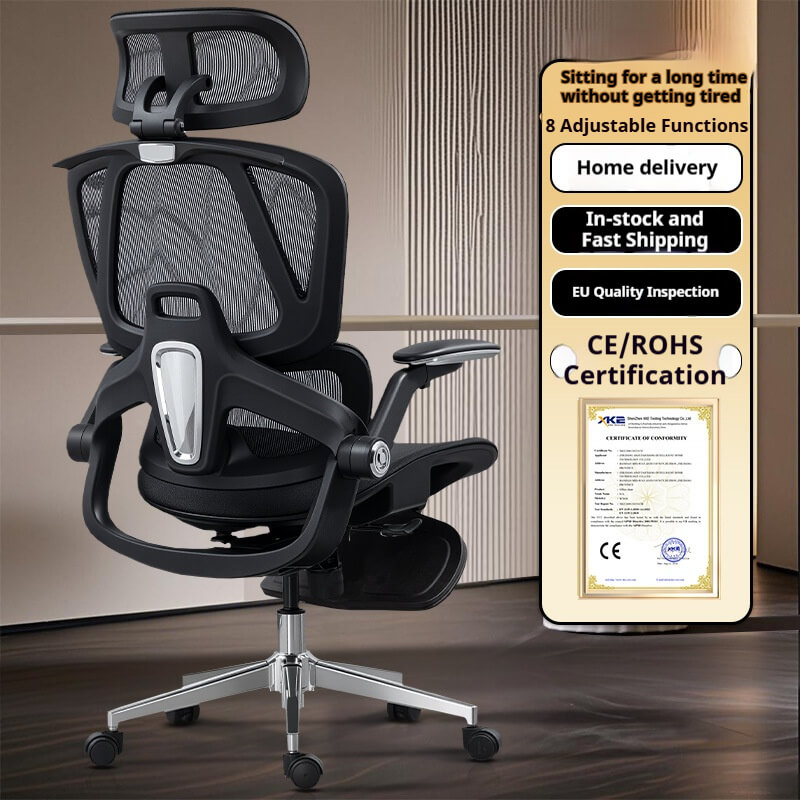
WARNING: If Your Current Procurement Process Fails This Index Test, Your Company May Face Seven-Figure Productivity Liabilities Over the Next Decade.
Introduction: An Unfalsifiable Balance Sheet
Forget all the marketing rhetoric about “ergonomics” you’ve ever heard.
We start with a cold, unavoidable financial fact: Based on the research model for knowledge workers from the Fraunhofer Society, a poorly designed or mismatched office chair causes an average of 45 minutes of “micro-distractions” and “posture readjustments” per employee per day. For a 100-person team, this equates to a loss of more than 9,375 working hours per year.
Calculate immediately what this number means for your company’s annual payroll budget.
This massive hidden liability will not appear on any financial statement, but it erodes your profits every single day. And traditional procurement processes are complicit in this problem.
The purpose of this article is not to “convince” — but to provide a diagnostic tool. This tool is called the Ergonomic Asset Performance Index (EAPI). It will replace all subjective, vague evaluation criteria and provide you with a quantifiable, auditable, and accountable supplier screening framework.
Audit your suppliers with the EAPI. They are either a “partner” that creates measurable assets for you, or a “cost center” that accumulates hidden liabilities for you. There is no middle ground.
Part 1: Index Construction Principles — Why Your “Due Diligence” May Be Merely a Formality
The EAPI is built to counter three “legitimate” forms of value deception in the industry:
The Compliance Illusion
Relying on safety certifications such as BIFMA for procurement decisions is equivalent to believing a driver with a license is necessarily an elite race car driver. Safety is the baseline, and your goal is performance. The EAPI focuses on the elements above the safety line that truly determine productivity returns.
The Feature-Stacking Trap
Suppliers show you 12-way adjustability features, much like software companies selling you an expensive package with 200 features you will never use. According to the Pareto Principle, 80% of ergonomic benefits come from just 20% of core mechanisms. The EAPI’s role is to identify and quantify that critical 20%.
The Material Information Gap
A supplier tells you they use “high-elastic mesh fabric” — a completely meaningless description. Is it German K+R or South Korean Wintex? Matrex or generic Chinese mesh? What is the wear resistance coefficient? What is the tension attenuation rate after three years? The EAPI will bridge this information gap with specific, verifiable industrial parameters.
Part 2: Core Tool — The Ergonomic Asset Performance Index (EAPI) Scorecard
INSTRUCTIONS: Print this scorecard and require your potential suppliers to provide evidence (test reports, material certificates, design drawings) for each item, then conduct scoring.
| Evaluation Dimension | Weight | Auditable Metrics | Scoring Criteria (1-5 Points) & Evidence Requirements |
|---|---|---|---|
| A. Core Biomechanical Engine | 40% | A1. Chassis Mechanism: Smoothness and followability of synchronous tilt | 1pt: Basic tilt.3pt: Synchronous tilt with obvious jolts.5pt: 4-axis or multi-axis linkage, automatic weight sensing, zero lumbar support loss during tilt.Evidence: Exploded view of chassis structure, dynamic ergonomic simulation video. |
| A2. Core Material – Gas Lift: Brand and certification grade | 1pt: Unknown brand.3pt: Certified brand (e.g., Lite, KGS), BIFMA Class 3.5pt: Premium brand (e.g., South Korean SHS), BIFMA Class 4 or TÜV Class 4.Evidence: Gas lift purchase order, brand and certification certificates. | ||
| A3. Core Material – Mesh: Performance attenuation rate | 1pt: Unable to provide data.3pt: Provides Martindale abrasion test result >50,000 cycles.5pt: Provides third-party report of permanent deformation rate <2% after 100,000 cyclic stretches under ISO standards.Evidence: Third-party laboratory test report. | ||
| B. Human-Computer Interaction Interface | 30% | B1. Adjustability Efficacy: Whether lumbar/armrest adjustment matches anthropometry | 1pt: Basic up/down adjustment.3pt: Multi-dimensional adjustment (up/down, forward/backward, rotation).5pt: Linked or adaptive adjustment, adjustment range explicitly covers the 5th-95th percentile of users.Evidence: Anthropometric database matching report. |
| B2. Task Adaptability: Designed for different work modes | 1pt: Single sitting mode.3pt: Supports forward tilt and recline.5pt: Explicitly designed with distinct support curves and lock angles for “Focus”, “Collaboration”, and “Relaxation” modes.Evidence: Product design white paper. | ||
| C. Total Lifecycle Value | 30% | C1. Modularity & Serviceability | 1pt: Full unit replacement only.3pt: Key components (casters, gas lift) replaceable.5pt: >90% of components available for independent ordering and replacement, with clear replacement tutorial videos.Evidence: Spare parts list and pricing, maintenance manual. |
| C2. Warranty Honesty | 1pt: Covers “structure” only.3pt: Explicitly lists covered components.5pt: Warranty explicitly covers performance attenuation (e.g., mesh sag, gas lift sinking) with a transparent warranty fulfillment process.Evidence: Detailed warranty document template. | ||
| C3. Partner Integrity: Ability to review and analyze failures | 1pt: Discusses only successes.3pt: Admits to minor past issues.5pt: Proactively and detailedly shares a Root Cause Analysis (RCA) report and process improvements for a major quality issue.Evidence: Redacted internal quality meeting minutes or improvement reports. |
EAPI Index Calculation Formula
EAPI Score = (A10.4 + A20.4 + A30.4) + (B10.3 + B20.3) + (C10.3 + C20.3 + C30.3)
(Simplified illustration; actual weights can be fine-tuned based on company needs)
Score Interpretation
- < 60 Points: High-Risk LiabilityThe supplier’s products will quickly become a black hole for maintenance costs and productivity within 2-3 years. Recommendation: Immediately remove from the candidate list.
- 60-80 Points: Compliant CommodityA usable product, but unable to generate additional alpha returns. Your return on investment will approach zero.
- > 80 Points: Performance AssetThe supplier has the ability to be your strategic partner, and their products will continuously generate positive productivity cash flow for you throughout their lifecycle.
Part 3: FAQ — Board-Level Questions and Responses
Q1: “This index is too stringent — will it eliminate all suppliers?”
A: “On the contrary, this is the index’s greatest value. It filters out more than 90% of factories that only want to make a ‘one-time sale’ from the start, allowing you to focus your precious negotiation and audit time on the top 10% of elite suppliers who truly have the strength and sincerity to be creators of ‘Performance Assets’.”
Q2: “We have no engineering background — how can we verify the authenticity of the reports submitted by suppliers?”
A: “You do not need to be an engineer. First, require all reports to be issued by third-party laboratories with CNAS/CMA qualifications, and provide a queryable report number online. Second, during a video factory audit, randomly assign one of their engineers and ask a question about a random data point in the report. Their reaction and fluency in answering are a more authentic ‘stress test’ than any document.”
Q3: “To score above 80 points, procurement costs may increase by 40% — how can this pass financial approval?”
A: “This is a classic confusion between ‘investment’ and ‘cost’. Let me rephrase the question: Are we willing to pay an additional 40% in capital expenditure now to avoid potentially 400% in operating expenditure over the next decade (calculated by productivity loss and replacement costs)? Products with a high EAPI score are essentially deflationary assets — their value increases with usage time. Low-score products, by contrast, are inflationary liabilities — their true cost skyrockets year after year.”
Final Action Directive: The Litmus Test
Stop sending RFQs (Request for Quotations).
Send this complete article, including the EAPI Scorecard, as a PDF to all your potential Chinese office chair suppliers.
The email body has only one sentence:
“Please review the attached framework. If you believe your company can meet the standards of a ‘Performance Asset’ supplier, please return the completed EAPI Scorecard with all required evidentiary documents within 10 business days.”
Their response — whether a high-quality professional report, a perfunctory sales pitch, an angry refusal, or complete silence — will be the only data you need to make the smartest, most unassailable procurement decision.