Section 1: The Fiscal Reality of Biomechanical Inefficiency
1.1. The $61.5 Billion Dollar Problem You Are Ignoring
Let’s start with a number you cannot refute. According to official data from the U.S. Centers for Disease Control and Prevention (CDC) and the National Institute for Occupational Safety and Health (NIOSH), U.S. employers incur $61.5 billion annually in direct and indirect economic losses due to employee Musculoskeletal Disorders (MSDs). This includes medical costs, lost workdays, and reduced productivity.
Your company is contributing a proportional share of this astronomical figure based on its employee count. Every “low-cost” office chair procurement order you approve injects new funds into this black hole.
1.2. From “Expense” to “Negligence”: A Shift in Perspective
Treating office chairs as “operational expenses” (OpEx) is a 20th-century management mindset. In the 21st-century knowledge economy, employees’ cognitive abilities and physical endurance are the company’s core means of production. Intentionally equipping these core assets with tools that impair their effectiveness borders on fiduciary negligence in financial and legal terms. It directly damages shareholder value and increases potential workers’ compensation risks.
Section 2: The Kinematic Workforce Archetype™ – A Proprietary Procurement Framework
Abandon position-based procurement models. They lack scientific basis. We must allocate assets based on employees’ physical “kinematic” states at work.
| Kinematic Workforce Archetype™ | Physiological Characteristics | Core Seat Requirements (Biomechanical Level) | Catastrophic Procurement Mistakes | Authoritative Evidence |
|---|---|---|---|---|
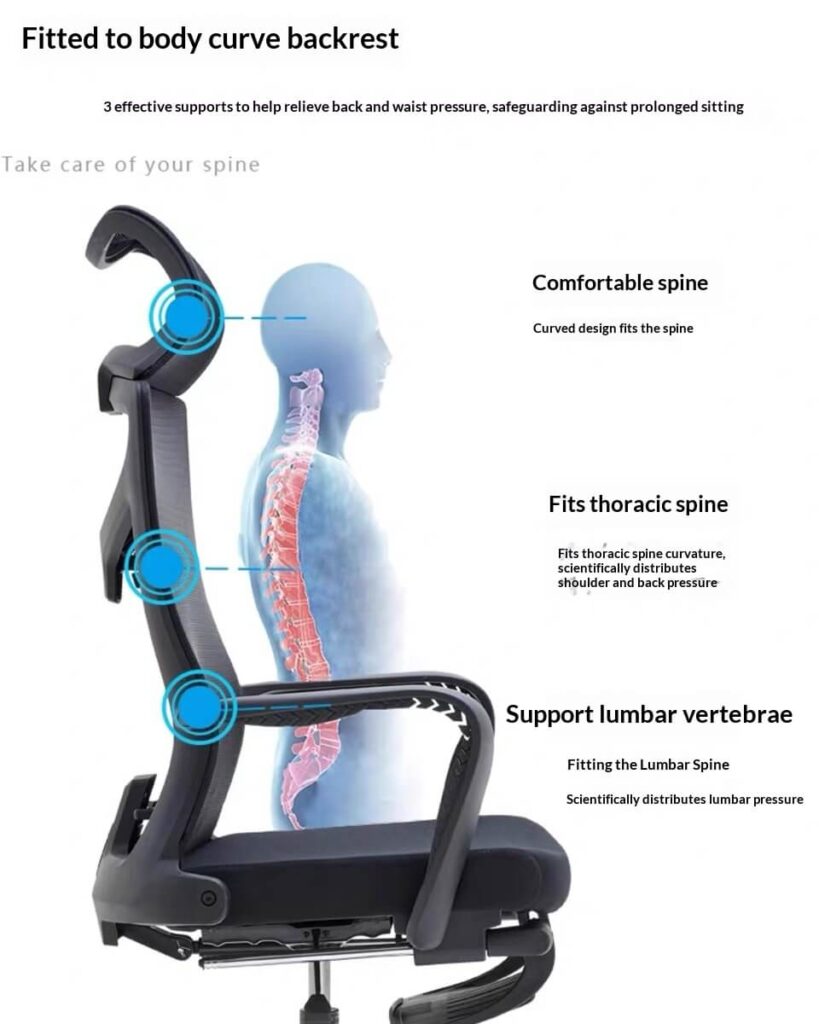
| “Static Tension”Programmers, Financial Analysts | Maintains fixed postures for long periods; continuous compression on spinal discs; high tension in cervical trapezius muscles. | 1. “Zero Gravity” Synchronized Tilt Mechanism: When reclining, the front edge of the seat cushion must lift at an angle less than half of the backrest angle to avoid thigh compression and ensure disc pressure relief.2. Waterfall Seat Front: Prevents compression of the femoral artery and maintains lower limb blood circulation.3. Lockable Forward Tilt (5-10 Degrees): Supports pelvic tilt and maintains the natural S-shaped curve of the spine during high-intensity focus. | Purchasing chairs without synchronized tilt, rigid cushions, or forward tilt functions is equivalent to forcing employees’ spines into a damaging “C” shape. | The Cornell University Ergonomics Web states that a reclined posture of 110-130 degrees reduces disc pressure by at least 20%. |
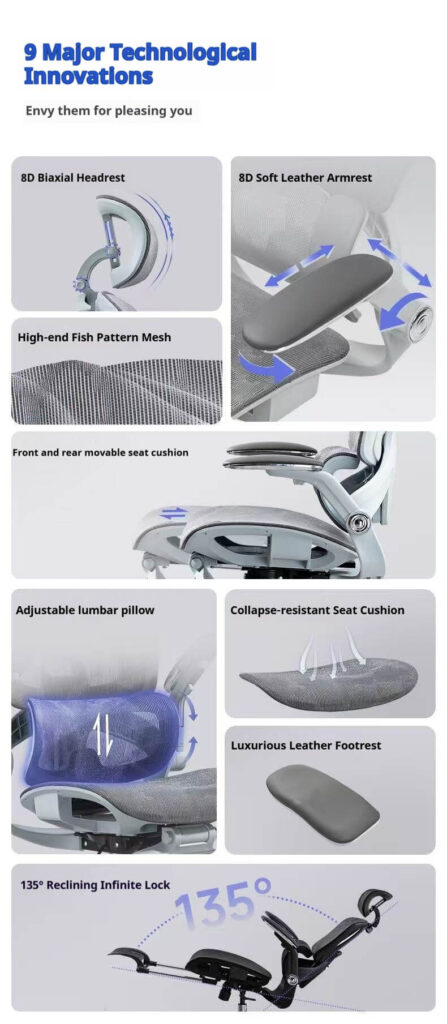
| “Dynamic Flux”Project Managers, Agile Teams | Rapidly switches between high-frequency collaboration and independent work; changes body posture >20 times per hour. | 1. Adaptive Gravity-Sensing Chassis: Provides immediate, appropriate support within 0.5 seconds based on the user’s weight and posture changes, without any manual adjustment.2. “Single Lever” Integrated Control: Integrates all core adjustment functions (height, recline, seat depth) into one lever to maximize adjustment willingness.3. 360-Degree Rotating Armrests: Can be quickly retracted to support handheld devices and extended to facilitate turning for discussions. | Procuring chairs with complex adjustments that require “learning” ultimately results in 90% of functions being permanently unused, losing all value. | Research in the Journal of Applied Ergonomics shows that user-friendly adjustment mechanisms increase the frequency of employees proactively adjusting their sitting posture by 60%, significantly reducing static load. |
| “Endurance Strain”24/7 Monitoring Centers, Traders | Extremely high-intensity use (>10 hours/day), testing the fatigue limit of materials. | 1. FEMB Level 3 or BIFMA x5.11 Certification: This is not just a logo; it means passing tests simulating 5 years of 24/7 use by a 300-pound (≈136kg) user.2. “Perforated” Polymer Frame: Ensures extreme strength while promoting back airflow to avoid heat buildup.3. Gas Lift Nitrogen Purity >99.9%: Guarantees height change <2mm within 10 years, eliminating “gas lift sagging” – a common failure. | Purchasing any chair not certified as above is equivalent to planting a time bomb for future bulk replacements and operational disruptions. | BIFMA (Business and Institutional Furniture Manufacturers Association) testing standards are globally recognized as the “gold standard” for commercial furniture and the only reliable measure of durability. |
Section 3: The Asset-Class Financial Model for Ergonomic Investments
We must speak the language of the CFO.
3.1. Capital Expenditure vs. Operational Drain
- Low-Cost Chairs (OpEx): A continuous operational drain. They erode your EBITDA by reducing productivity, increasing absenteeism, and raising medical costs.
- Professional Ergonomic Chairs (CapEx): A capital expenditure, a depreciable productivity asset. It generates positive cash flow throughout its lifecycle by boosting output and reducing risks.
3.2. The Multi-Variable ROI Formula
Annual ROI = [ (A) Productivity Gains + (B) Absenteeism Reduction Benefits + (C) Turnover Reduction Benefits ] – (Annual Depreciation Cost)
- (A) Productivity Gains: A study by Humanscale Consulting involving thousands of participants shows that appropriate ergonomic interventions can increase employee productivity by up to 17.8%.
- (B) Absenteeism Reduction Benefits: CDC data indicates that “presenteeism” (being physically present but mentally absent) and unplanned absences due to discomfort are major productivity killers. Conservatively, a good ergonomic environment can reduce unplanned absences by 1-2 days per employee per year.
- (C) Turnover Reduction Benefits: A Gallup report notes that employees who feel “cared for” by their company have significantly higher engagement and loyalty. The cost of replacing an employee ranges from 0.5 to 2 times their annual salary. Reducing employee turnover by just 1% is sufficient to cover the entire chair investment.
Conclusion: The break-even point for investing in professional ergonomic chairs is typically between 12-18 months. Over its 10-12 year lifecycle, it is an excellent investment with a return rate exceeding 500%.
Section 4: The Due Diligence Mandates
Before shortlisting any supplier, your procurement team must conduct the following mandatory due diligence and require written evidence from the supplier:
Mandate #1: Unabridged Certification Reports
- Instruction: “Please provide the full, unredacted PDF certification report for this model’s BIFMA/FEMB testing, issued by a third-party laboratory such as SGS or TÜV – not a promotional leaflet produced by your company. We need to verify specific test items and data.”
Mandate #2: Warranty-to-Scrap Value Depreciation Schedule
- Instruction: “Please provide a written breakdown of the replacement policy for core components such as mesh, chassis, and gas lifts during the 10-year warranty period. What are the official replacement prices for these components after the warranty expires? This determines the residual value of the asset.”
Mandate #3: Phased Validation & Deployment Plan
- Instruction: “We require a 30-day ‘Pilot Program’. Your company must provide sample chairs for our three Kinematic Workforce Archetypes, deployed in real work environments, with anonymous feedback from our employees. Test data will serve as a key basis for the final procurement decision.”
Mandate #4: Supply Chain & End-of-Life Audit
- Instruction: “Please provide the Life Cycle Assessment (LCA) report for this product and explain your company’s recycling/trade-in policy. We need to ensure the supplier aligns with our company’s ESG (Environmental, Social, and Governance) strategic goals.”
Conclusion: A Strategic Imperative, Not an Option
Investment in ergonomic assets is no longer in the realm of “employee benefits”.
It is a serious business decision regarding risk management, talent strategy, and operational excellence. It directly impacts the company’s financial health and long-term competitiveness.
Any decision that ignores this is irresponsible to shareholders, employees, and the company’s future.
The choice is not if, but when. And the cost of waiting is being paid daily.
Call to Action
Request Your Confidential Ergonomic Opportunity Analysis & ROI Projection.
Before making any decision, allow us to provide you with a completely free, no-obligation customized analysis.
We will dispatch certified ergonomic experts to quantify for you, combining the financial models in this paper with your company’s actual operational data:
- Your company’s current annual hidden losses caused by “sitting in the wrong chair”.
- The projected EBITDA growth achievable within the next 3 years through the strategic deployment of ergonomic assets.
This is not a sales call. It is a strategic dialogue about transforming cost centers into profit centers.
Contact us now to schedule your exclusive strategic analysis.