In the office furniture industry, your greatest threat isn’t a competitor’s lower price—it’s the dead stock suffocating your cash flow.
For overseas buyers, the dilemma is binary: you want to test a new model with a small batch, but Chinese factories demand a 500-unit minimum or a full 40HQ container. If you yield, you are gambling $40,000+ on an unproven product, plus the compounding interest of monthly warehousing fees.
If you are searching for solutions, you likely find two extremes: overpriced middleman traders or factories trying to dump canceled orders and B-grade stock on you.
This guide strips away the marketing jargon to explain the cold physics of manufacturing and how to strategically navigate the “MOQ Trap.”
The Insider Truth: Why “Standard” Factories Fight Low MOQs
When a factory insists on a high MOQ, it isn’t out of arrogance; it’s a survival mechanism based on the physics of mass production. Understanding this allows you to spot a “fake” low MOQ offer before it ruins your reputation.
- The Sunk Cost of Machine Downtime: Ergonomic chairs rely on heavy injection molding for backframes and bases. A single mold change and machine calibration can take 4–6 hours. For a 50-unit run, the labor and energy costs of “setting up” often exceed the actual value of the production run.
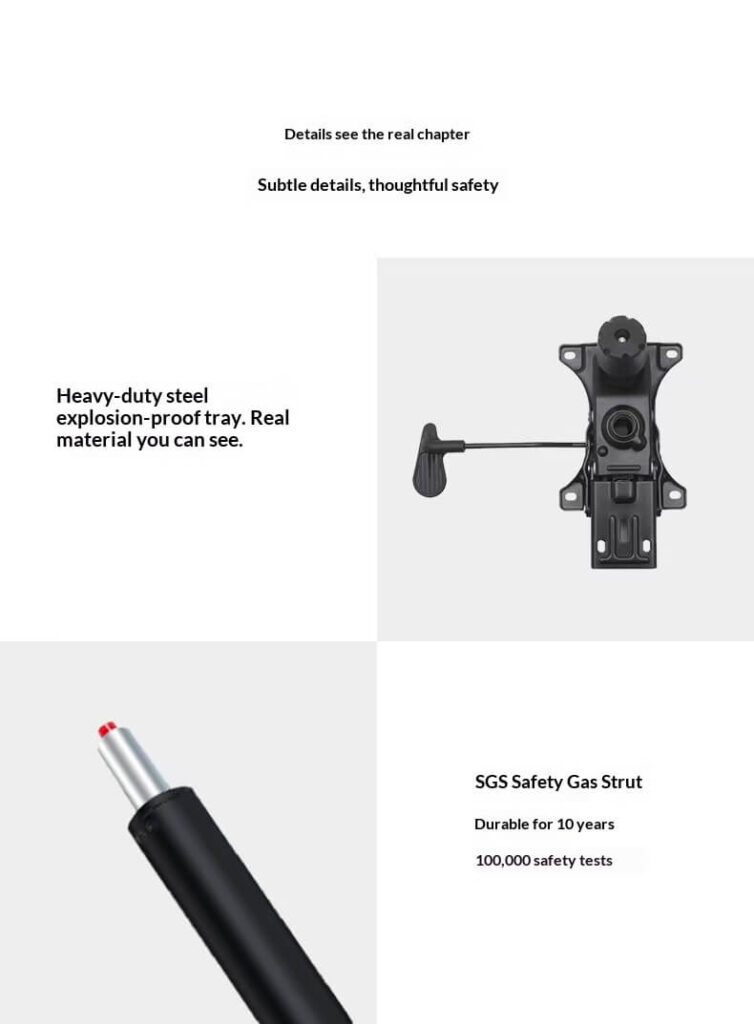
- Upstream “Choke Points”: A chair is an assembly of 30+ components. Premium Korean mesh suppliers often have 500-meter minimums. BIFMA-certified Class 4 gas lifts and heavy-duty mechanisms are rarely sold in small quantities by hardware sub-vendors.
- The “Dark Side” of Small Batches: If a traditional mass-production factory suddenly agrees to a tiny order at a rock-bottom price, proceed with extreme caution. Usually, you are buying leftover scraps:
- Inventory Clearance: You receive units from a canceled order or “B-grade” stock with slight cosmetic defects.
- Substandard Components: To avoid buying new materials, they use “aged” gas lifts or mismatched mesh lots from three years ago. If a gas lift fails in your market, the liability is 100% yours.
The Financial Reality: Calculating Your TCO (Total Cost of Ownership)
B2B procurement is a game of Inventory Turnover. According to data from the Council of Supply Chain Management Professionals (CSCMP), annual inventory carrying costs—including insurance, taxes, and warehouse space—typically range from 20% to 30% of the inventory value.
Compare the “Container Gamble” against a strategic low moq ergonomic chair wholesale approach:
| Cost & Risk Metric | Traditional Factory (500 Units / 40HQ) | Strategic Low MOQ (50 Units / Test Phase) |
| Initial Capital Tie-up | $35,000 – $50,000 (Liquid asset locked) | $3,500 – $5,500 (Preserved liquidity) |
| Annual Carrying Cost | $7,000 – $15,000 (Hidden drain) | Negligible (High velocity) |
| Market Risk | Extreme (If the model fails, you go bust) | Controlled (Failure is a cheap lesson) |
| Quality Consistency | High (Mass production stability) | High (Only with Modular Supply Chains) |
| Agility | Zero (You are stuck with that design) | High (Modify specs based on V1 feedback) |
The verdict: Saving 10% on unit price by forcing a container load is often the most expensive mistake a buyer can make.
Our Infrastructure: Modular Supply Chain vs. Mass Production
We do not claim to be the “biggest” or “best.” Instead, we have re-engineered our supply chain specifically to facilitate without compromising BIFMA X5.1 standards.
We achieve this through Modular Pre-stocking:
- Chassis Standardization: We absorb the financial risk of upstream MOQs by maintaining a permanent stock of 2,000+ high-spec universal components (Class 4 gas lifts, aluminum bases, and multi-functional mechanisms).
- “Lego-style” Assembly: When you order 50 units, we aren’t starting from scratch. We are configuring our pre-certified “core” with your specific choice of mesh, armrests, and headrests.
This allows you to access factory-direct pricing for small batches while maintaining the same structural integrity as a 10,000-unit run.
Hard Talk: Low MOQ FAQ & Risk Mitigation
Q: Why is your Low MOQ price 15% higher than the container price? A: This is an honest premium. It covers the interest on the capital we tie up in pre-stocked components and the labor inefficiency of small-run assembly. Any supplier offering “50 pieces at 5,000-piece pricing” is hiding a quality deficit elsewhere.
Q: Does LCL (Less than Container Load) shipping negate the savings? A: On a per-unit basis, yes, shipping is more expensive. However, as your “insider partner,” we advise looking at the Risk-Adjusted Cost. Spending an extra $15 on shipping per chair is a cheap insurance policy compared to the risk of $40,000 in unsellable inventory.
Q: Are these chairs BIFMA certified even in small batches? A: Yes. Because the load-bearing components are identical to our mass-production runs. We do not manufacture “cheap versions” for small orders; it would disrupt our standardized assembly line.
Next Step: Access Our Modular BOM Matrix
Stop gambling on “gut feelings.” Before you commit to a bulk order with any factory, you need to understand the true cost of a market test.
Instead of sending you a generic marketing catalog, we provide a Modular BOM (Bill of Materials) Matrix. This document shows you exactly how much your 50-unit test batch will cost based on different component configurations—no fluff, just raw data.