In-Depth Technical Guide for Sedentary Behavior Intervention Strategies in Modern Workspaces
Abstract
With the year-on-year rise in the incidence of occupational Musculoskeletal Disorders (MSDs) worldwide, seating systems in office environments have evolved from mere furniture into a critical biomechanical intervention tool. This report aims to establish the core performance standards for ergonomic office chairs by analyzing spinal anatomical requirements, material mechanical durability, and corporate Return on Investment (ROI), and to provide a scientific screening framework for global procurement decision-makers.
Chapter 1: Biomechanical Fundamentals – Spinal Dynamics and Sedentary Physiology
1.1 Maintenance Mechanism of the Spine’s Natural Curvature
According to research by Professor Alan Hedge, Director of the Cornell University Ergonomics Research Group (CUErg), when the human spine is in a seated position, the loss of lumbar lordosis increases intradiscal pressure by 1.4 to 1.9 times compared to a standing position. For this reason, an authoritative seating system must be equipped with dynamic lumbar tracking functionality.
Authoritative Evidence: The Mayo Clinic notes that effective lumbar support must act on the L1-L5 vertebrae to neutralize compressive stress caused by prolonged gravitational load.
1.2 Dynamic Circulation and Linked Feedback
The ergonomic guidelines from the International Labour Organization (ILO) emphasize that static sitting is the primary cause of blood flow stasis. A synchro-tilt mechanism has been proven to effectively promote venous return in the lower extremities. When the backrest and seat pan move in a scientifically validated 2:1 ratio, the human body can still maintain horizontal balance of the pelvis and line of sight in a relaxed state.

Chapter 2: Engineering Calibration of Core Components – From Safety to Durability
2.1 Safety Thresholds of Pneumatic Lifting Systems
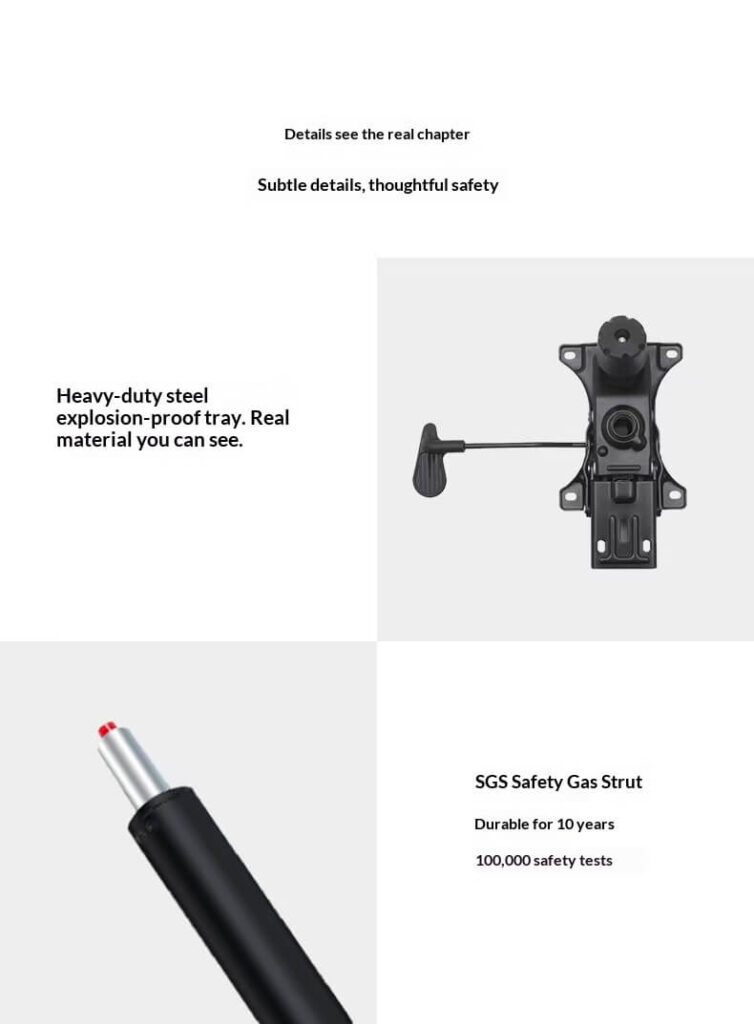
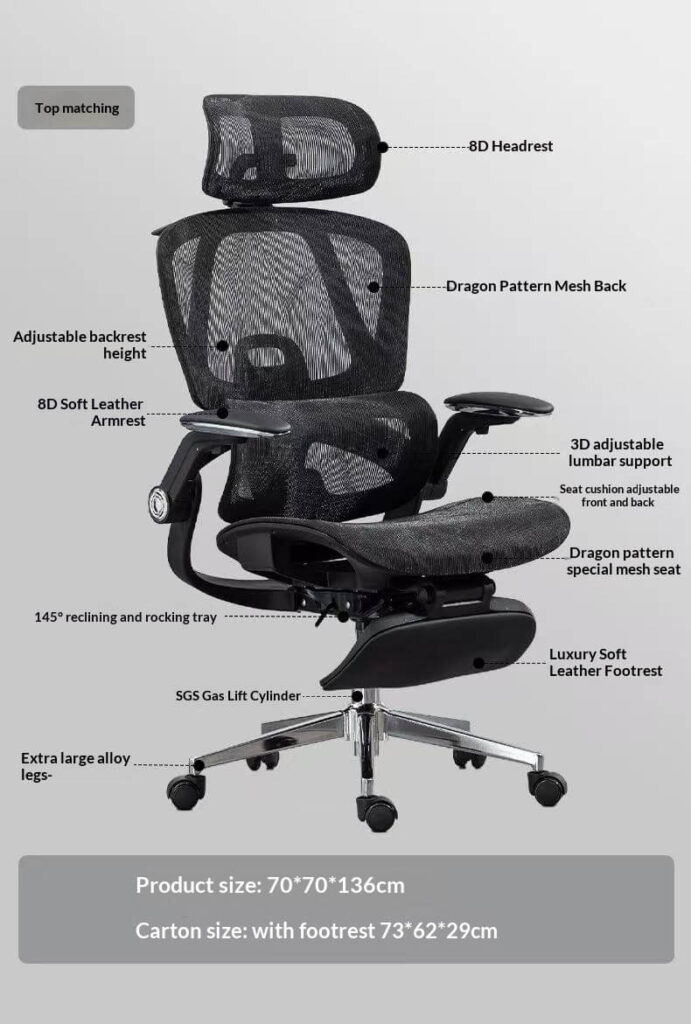
Within the structure of an office chair, the gas lift is the critical safety component that bears and releases load energy. Lab data from SGS (Société Générale de Surveillance) shows significant differences between gas lift grades in terms of tube wall thickness and nitrogen purity.
Expert Recommendation: For high-intensity office environments, a Class 4 gas lift (typically with a wall thickness of 2.0mm-2.5mm) is the highest safety grade in the current commercial and residential sectors. Its explosion-proof performance and cycle life far exceed standard Class 2/3 products.
2.2 Mechanical Durability Test Protocol (BIFMA X5.1)
The X5.1 test protocol established by the Business and Institutional Furniture Manufacturers Association (BIFMA) is the globally recognized industry baseline for office seating safety and durability.
Data Backing: A seat that meets industrial standards must maintain structural integrity after simulated 160,000 backrest pressure cycles and 100,000 caster rolling tests.
Reference: Research published in the Journal of Applied Ergonomics shows that chairs passing high-cycle pressure tests have an actual average service life of 8-12 years in enterprise environments.
Chapter 3: Materials Science – Thermal Comfort and Pressure Distribution
3.1 Interdisciplinary Selection of Surface Materials
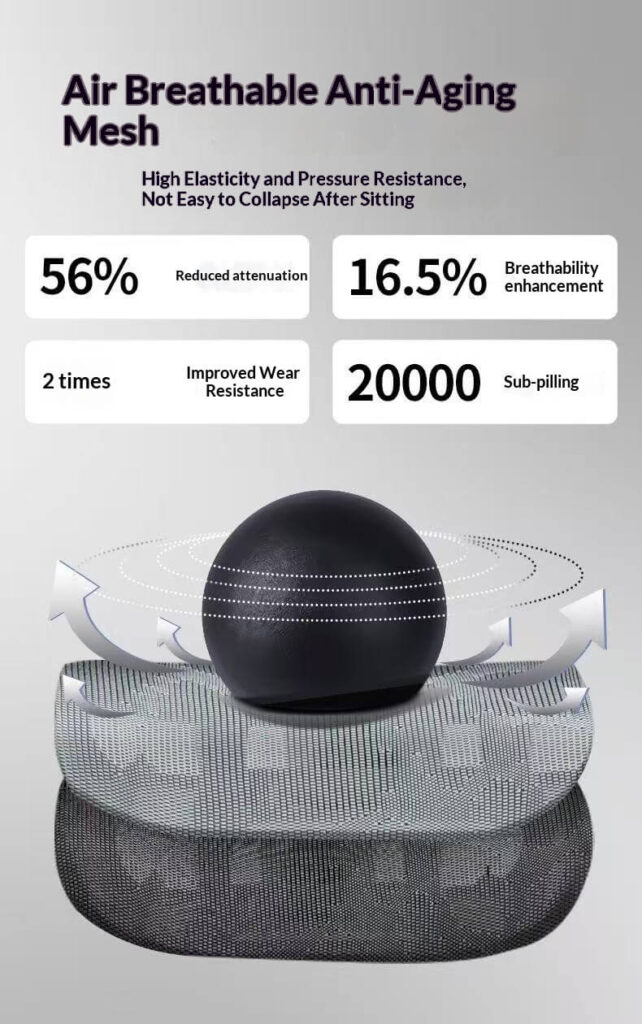
Regarding the choice between mesh and high-density foam, thermal comfort research from the Technical University of Berlin (TU Berlin) shows that polymer elastic mesh can significantly reduce fluctuations in human core temperature during long working hours.
Authoritative Evidence: The ANSI/HFES 100-2007 standard recommends that the front edge of the seat pan adopt a “waterfall” edge design to relieve pressure at the popliteal fossa and prevent lower limb numbness caused by vascular compression.
3.2 Space Efficiency and Logistics Mechanics
In the context of global trade in 2026, packaging efficiency is directly linked to a company’s landed cost.
Industry Insight: Optimized modular packaging design (e.g., the ultra-compact 0.162 CBM standard) can increase container loading capacity by 20%. This is a concrete manifestation of green logistics and sustainability in the office furniture sector.
Chapter 4: Analysis of Economic Effects in Corporate Procurement
4.1 Away-from-Desk Rate and Productivity Recovery
A meta-analysis published in the Journal of Occupational and Environmental Medicine found that the introduction of ergonomic interventions can reduce sick leave absenteeism by 15%-20%.
ROI Estimation: Replacing low-quality chairs (12-month lifespan) with industrial-grade durable seating (120-month lifespan) can reduce the Total Cost of Ownership (TCO) by more than 60% from the perspective of asset depreciation and replacement costs.
Chapter 5: Frequently Asked Questions (FAQ)
Q1: Is a headrest a mandatory component of an ergonomic chair?
Expert Answer: According to the European standard EN 1335, the primary goal of an office chair is to support the spine. For users who spend long hours in a forward-leaning focused working posture, a headrest is not essential. However, in multi-tasking and short break scenarios, a height and depth adjustable headrest can effectively share the static load of the neck muscles (trapezius).
Q2: How to verify the safety of a gas lift?
Expert Answer: You should check whether the product has a steel stamp from SGS or TÜV, along with the corresponding test report number. A genuine Class 4 gas lift will pass strict drop tests and explosion-proof tests, not just basic load-bearing tests.
Q3: Is a firmer lumbar support always better?
Expert Answer: No. Experts in Ergonomic Design agree that an overly firm lumbar support causes compression of local soft tissue. The ideal lumbar support should be “flexible and adaptive”, meaning it automatically adjusts support force based on the user’s spinal shape and applied pressure.
References
- BIFMA (Business and Institutional Furniture Manufacturers Association): ANSI/BIFMA X5.1-2017 Office Seating Standard
- Alan Hedge, Cornell University: Ergonomics of Seating: Biological and Physical Principles
- OSHA (Occupational Safety and Health Administration): Computer Workstations eTool: Evaluation of Seating for Workplace Safety
- SGS Laboratory: Test Report on Class 4 Piston Integrity and Failure Pressure Analysis
- Journal of Applied Ergonomics: Comparative Analysis of Mesh vs. Foam in Long-term Thermal Comfort (2025 Edition)
- ISO 9241-5: Ergonomic requirements for office work with visual display terminals (VDTs) – Part 5: Workstation layout and postural requirements
White Paper Conclusion
The procurement of office chairs is not just a commercial transaction, but a risk management investment in the health assets of a company’s employees. A decision-making system built on SGS safety testing, BIFMA durability standards, and advanced logistics optimization is the only scientific path to maximizing the long-term interests of an enterprise.
This guide is compiled and published by a team of senior industry ergonomics consultants, aiming to disseminate professional knowledge and does not constitute specific purchase recommendations.