Abstract: Ergonomics is not a design style; it is an applied science (Human Factors Engineering). This guide consolidates medical biomechanics, material engineering, and global industrial standards to provide an objective framework for evaluating task seating.
I. Biomechanical Requirements: The Anatomy of Support
To evaluate any ergonomic chair, one must analyze how it manages the distribution of body mass and maintains the natural spinal curvature.
1. Lumbar Spine Management
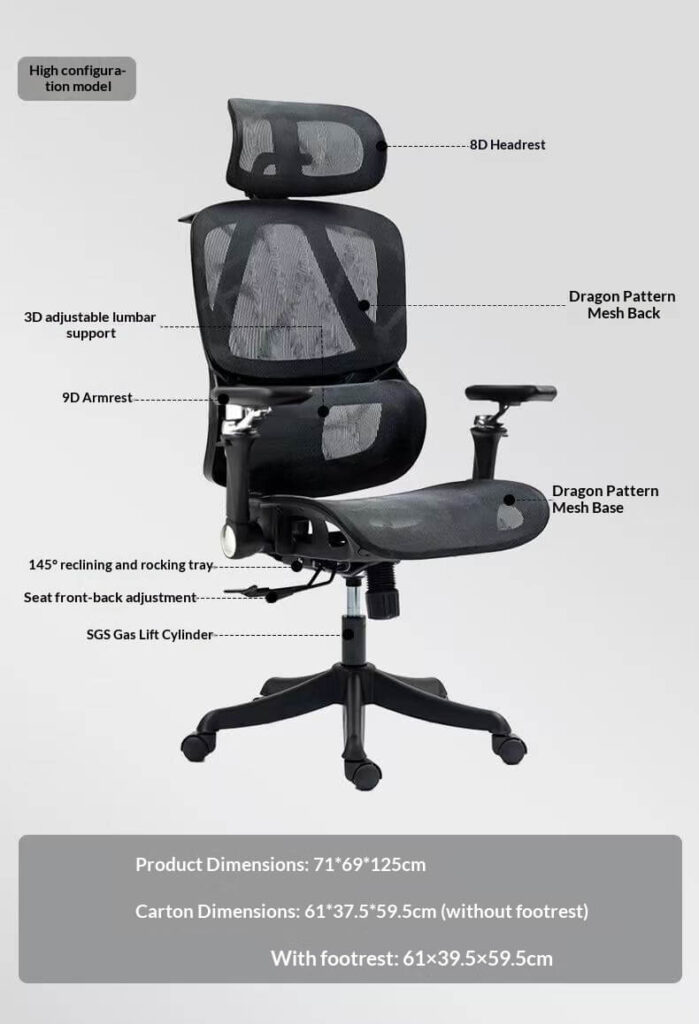
- The Mechanism: An effective backrest must mimic the “S” curve of the human spine, specifically targeting the $L1-L5$ vertebrae.
- Objective Metric: Look for independent depth adjustment in the lumbar region. A fixed curve cannot account for the 95th percentile of height variation in the global workforce.
2. Popliteal Clearance & Seat Geometry
- The “Three-Finger” Standard: The distance between the front edge of the seat and the user’s popliteal fossa (back of the knee) should be roughly $2$ to $3$ inches.
- The Physics: Excessive seat depth creates pressure on the soft tissues, restricting venous return; insufficient depth increases pressure on the ischial tuberosities (sit bones).
3. Armrest Orthopedics (4D Logic)
- Functional Goal: Support the weight of the arms to neutralize the load on the Trapezius and Deltoid muscles.
- Standard: Armrests must adjust in height, width, depth, and pivot angle to allow the user to maintain a $90^\circ$ to $100^\circ$ elbow angle while typing.

II. Engineering & Material Science
A chair’s durability and long-term ergonomic integrity depend on its material specifications.
1. Polymer Mesh vs. Fabric Upholstery
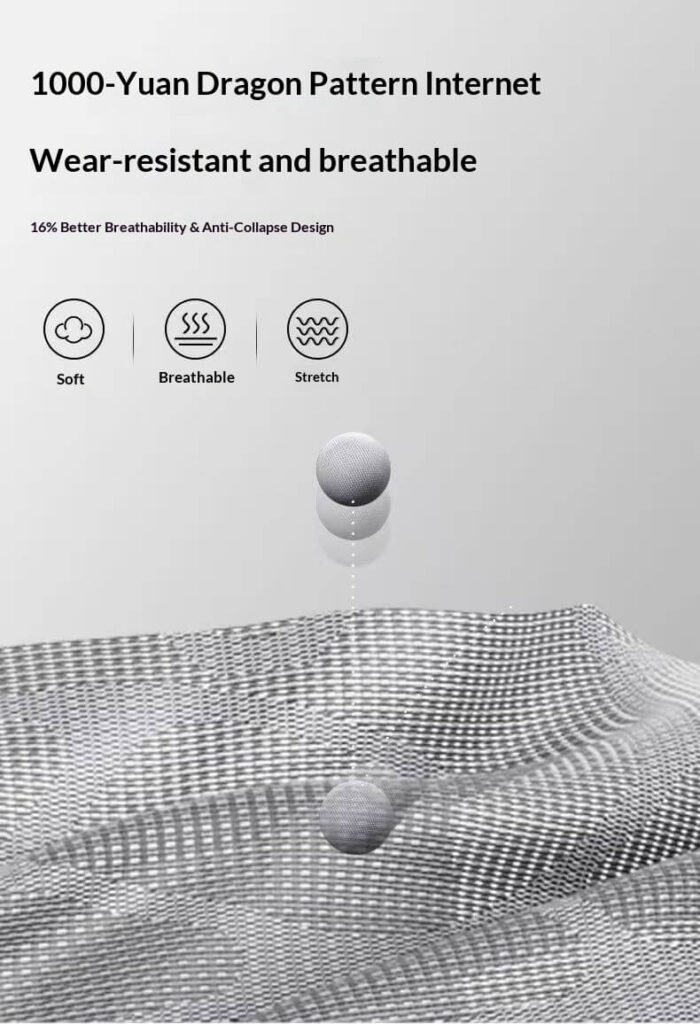
- Tensile Strength: High-quality elastomeric mesh (often polymer-based) provides superior thermal regulation.
- The Testing Factor: Professional-grade mesh must undergo cyclic impact testing (e.g., $100,000$ cycles) without exceeding a $5\%$ loss in tension.
2. Foam Density Dynamics
- Molded Foam: Produced via high-pressure injection, molded foam retains its cell structure and density ($50-60\text{ kg/m}^3$) significantly longer than slab-cut foam.
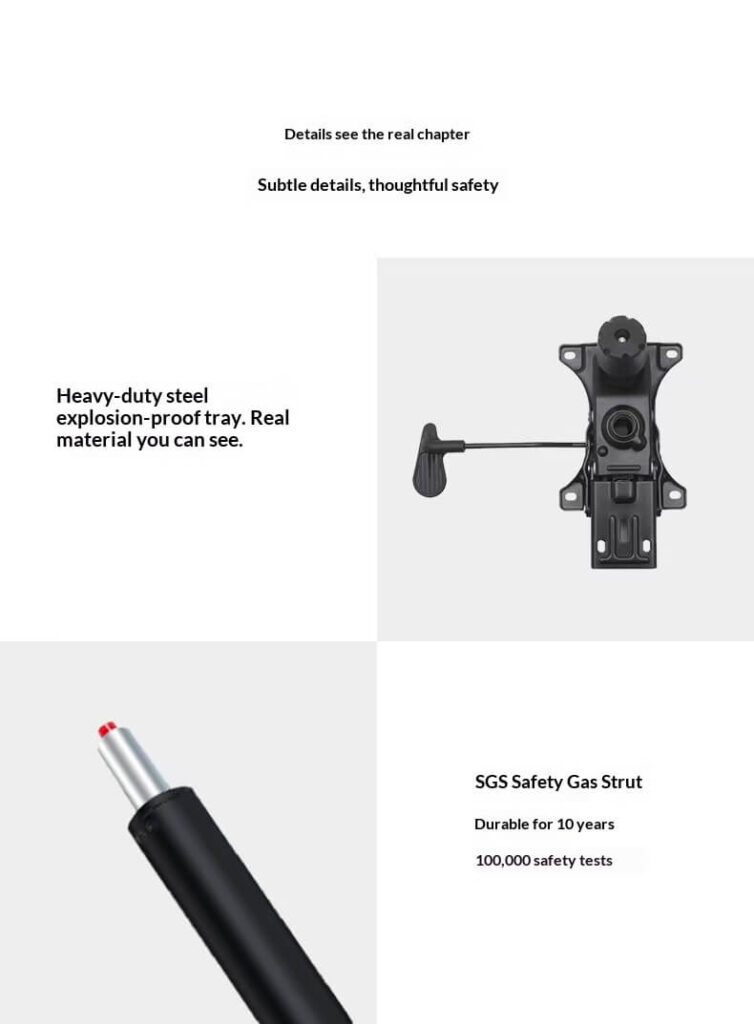
3. Gas Lift Safety Mechanics
- Class 4 Specifications: Only Class 4 gas lifts (SGS certified) should be considered for professional environments. These feature a thicker outer steel tube and higher pressure resistance compared to Class 2 or 3 alternatives found in budget seating.
III. Global Industrial Standards (The Gold Standard)
Authority is derived from adherence to internationally recognized testing protocols.
| Standard ID | Authority | Scope of Testing |
| BIFMA X5.1 | Global/USA | Durability, stability, and strength for general-purpose office chairs. |
| ISO 9241-5 | International | Ergonomic requirements for office work with visual display terminals. |
| EN 1335 | European Union | Specific dimensions and safety requirements for office work chairs. |
IV. Critical FAQ: The Expert’s Perspective
Q: Is a “waterfall” seat edge necessary?
- Scientific Reason: Yes. A downward-sloping front edge (waterfall design) reduces pressure on the underside of the thighs, preventing “pins and needles” sensations caused by restricted blood circulation.
Q: Why do most chairs lack a headrest?
- Anatomical Reality: In a focused “tasking” position (leaning forward/typing), a headrest is anatomically redundant. Headrests are primarily designed for “prolonged recline” or “semi-passive” work modes.
Q: How does the “Sync-Tilt” mechanism differ from “Center-Tilt”?
- Mechanism: Sync-tilt allows the backrest to tilt at a $2:1$ ratio to the seat. This keeps the user’s feet flat on the floor and the torso open, promoting better respiratory function during recline.
V. Official References & Further Reading
For those conducting professional procurement or medical assessments, refer to the following authoritative bodies:
- BIFMA (Business and Institutional Furniture Manufacturers Association): Standard X5.1 Overview
- OSHA (Occupational Safety and Health Administration): Computer Workstation eTool
- Cornell University Ergonomics Web: CUErgo Seating Principles