Replace Discontinued Mechanisms Without Compromising the Chair
Finding a replacement mechanism for a discontinued executive chair can be difficult when the available replacements use different mounting patterns, tilt functions, or seat geometry.
The same problem appears when developing a new seating product: standard mechanisms can force the seat pan to follow someone else’s hole pattern instead of your own design.
Our approach is to combine ready-to-use tilt mechanisms with engineering-based interface customization, allowing the replacement or new mechanism to be matched to the actual chair geometry and functional requirements.
Suitable for:
- discontinued executive and task chairs
- commercial refurbishment
- premium seating upgrades
- OEM seating programs
- small-batch development
- custom chair mechanisms
Heavy-Duty Mechanism Options
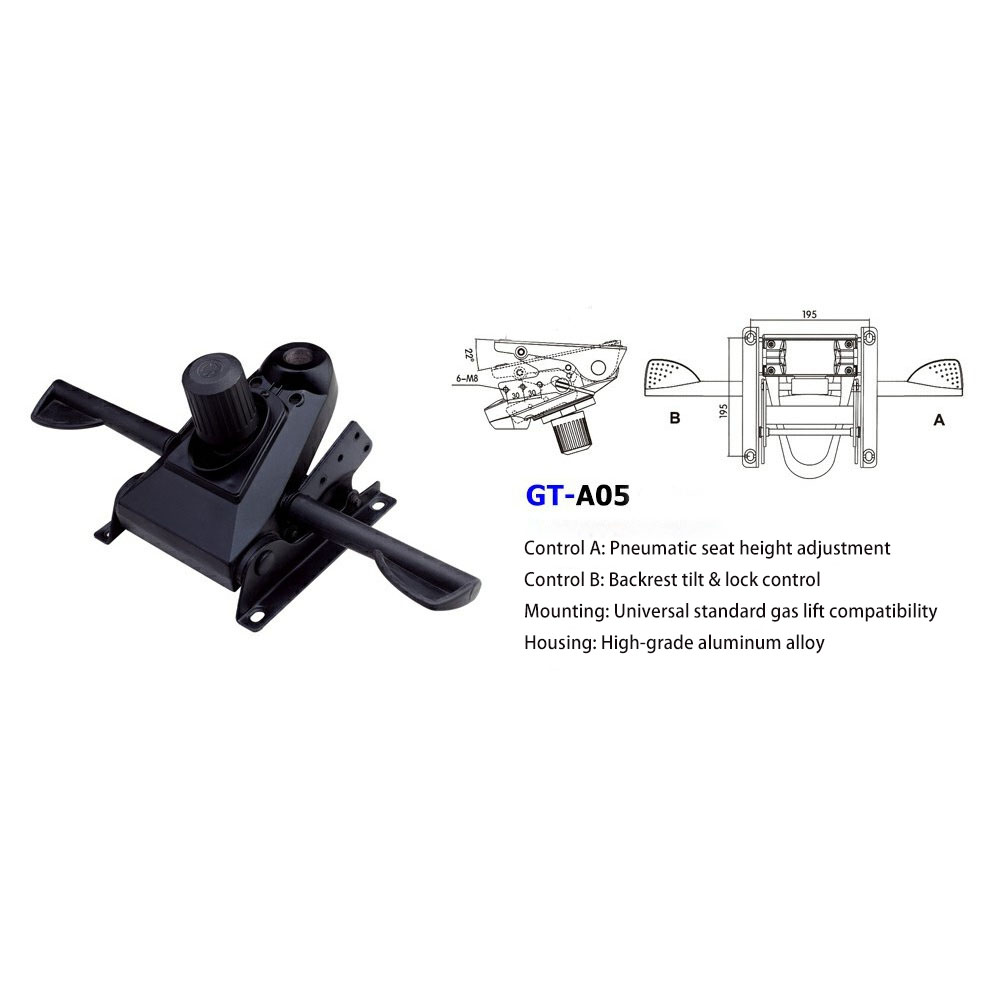
Different seating applications require different control functions.
Available configurations include:
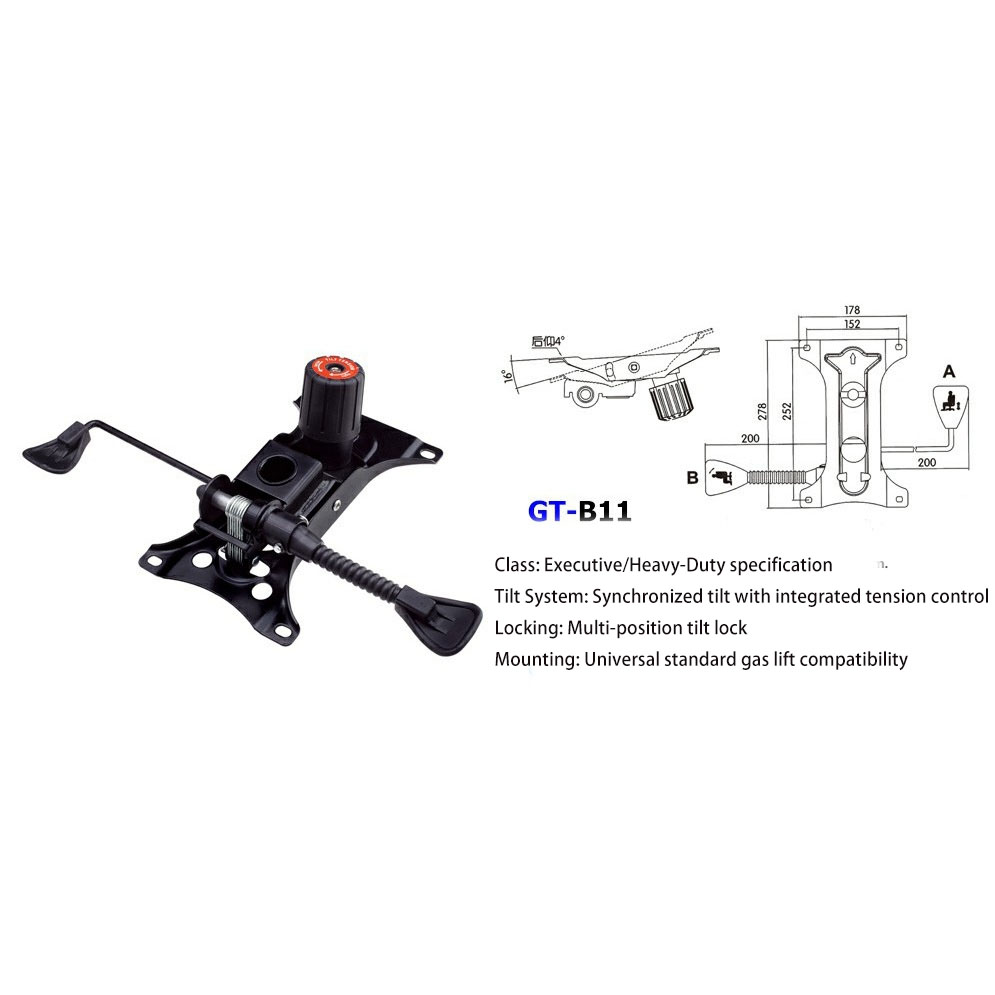
GT-B11 — Heavy-Duty Synchro Control
Designed for demanding commercial seating applications, including higher-load executive and bariatric seating.
Features may include:
- synchronized seat/back tilt movement
- integrated tension adjustment
- heavy-duty structural construction
- commercial-use configuration
The final mechanism should be selected according to the complete chair structure, intended load, and operating conditions.
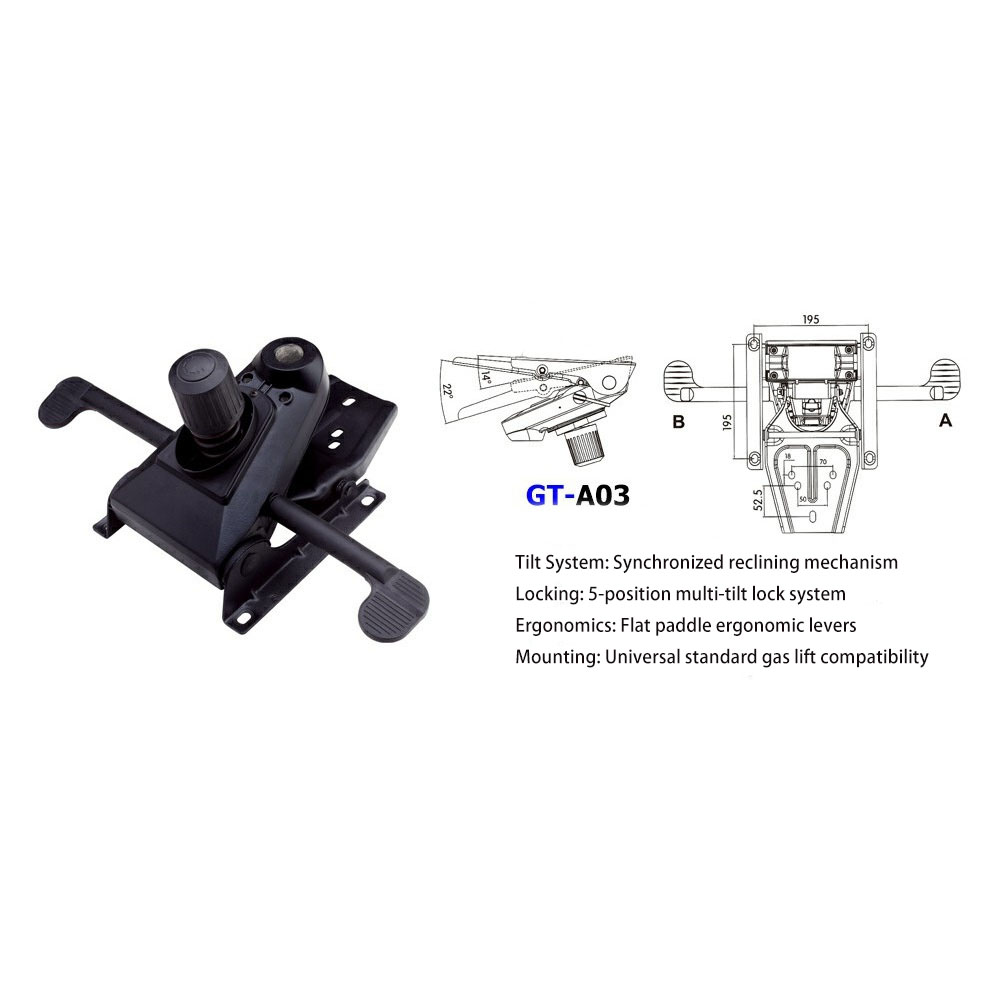
GT-A03 — 5-Position Multi-Tilt Lock
Designed for premium task and executive seating where multiple locked working positions are required.
Features include:
- 5-position tilt locking
- multi-tilt functionality
- ergonomic paddle-style levers
- configurable control arrangement
This configuration can be used when a higher level of adjustment is required than a basic tilt mechanism provides.
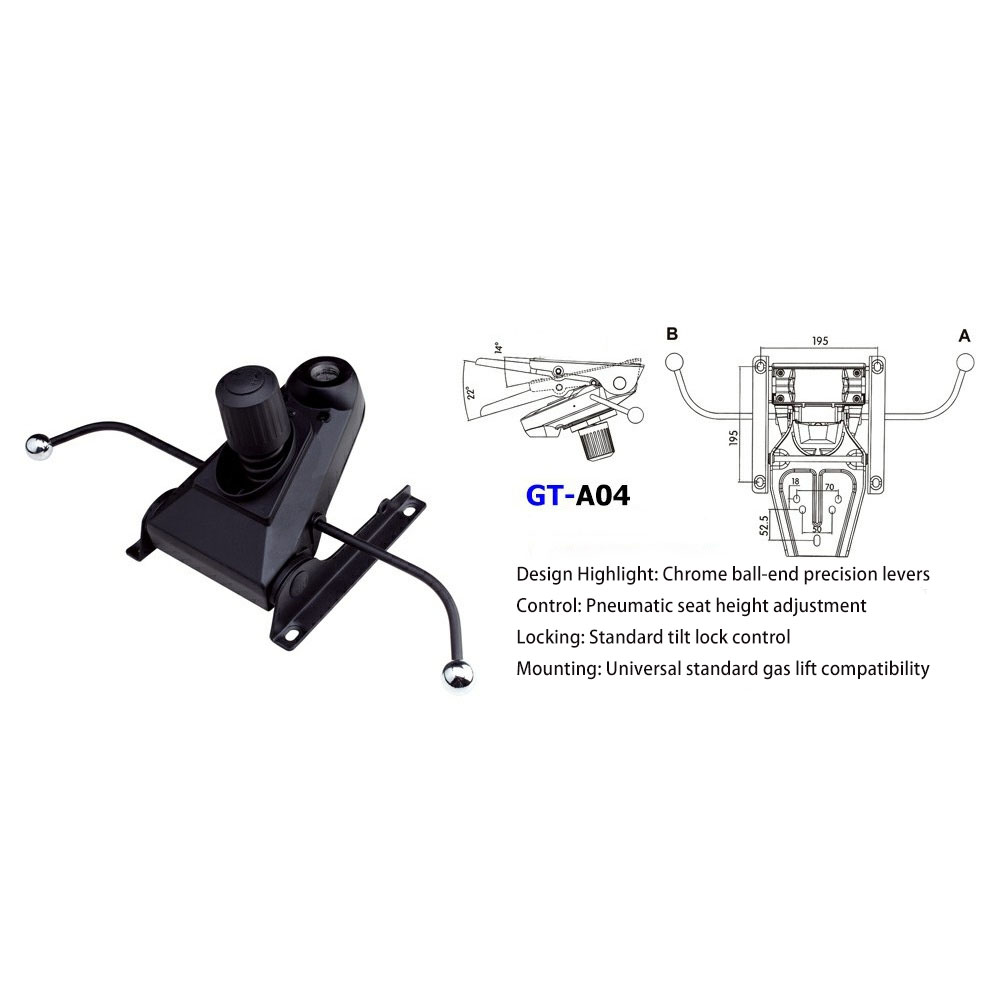
GT-A02 / GT-A04 — Custom Forward-Pitch Configurations
For seating applications requiring a controlled forward-pitch geometry, selected configurations can incorporate approximately 3° forward pitch according to the required design.
This can be considered for:
- ergonomic workstation seating
- task-focused applications
- custom OEM seating
- specialized seat-pan geometry
The final angle should be verified against the chair’s seat pan, backrest, mechanism geometry, and intended ergonomic position.
Custom CNC Mounting Interface
The Mounting Pattern Should Follow the Chair — Not the Other Way Around
One of the most common problems with replacement mechanisms is mounting-hole mismatch.
A mechanism may function correctly but still be unusable because:
- hole spacing is different;
- the mounting reference is different;
- the seat-pan geometry has changed;
- the fastener locations do not provide sufficient engagement.
Instead of forcing the chair to match a standard mechanism, the mounting interface can be engineered around the actual seat-pan geometry.
Available engineering inputs can include:
- physical mechanism sample
- physical seat-pan sample
- dimensional measurements
- 3D CAD data
- photographs and reference dimensions
The interface can then be mapped and validated before larger-volume production.
Functional Calibration
A mechanism is not defined only by its mounting holes.
The functional behavior can also require verification, including:
- tilt resistance
- spring tension
- lever actuation
- locking positions
- seat/back synchronization
- operating range
Where project requirements call for specific testing or customer-defined standards, the appropriate mechanism configuration and validation process can be established accordingly.
Any specific certification or test claim should be confirmed against the actual mechanism configuration and applicable test documentation.
Lever & Finish Customization
For OEM and refurbishment programs, the visible control hardware can be adapted to the intended product design.
Potential options include:
- custom lever geometry
- custom lever length
- black polymer finishes
- polished finishes
- chrome-effect finishes
- project-specific appearance requirements
This allows the replacement mechanism to integrate more naturally into an existing chair design or a new seating platform.
FAQ — Tilt Mechanism Selection, Compatibility & Customization
Why can a replacement tilt mechanism fail even when the mechanism itself works correctly?
Because the mechanism and the chair are a system.
Compatibility can depend on:
- mounting hole pattern
- seat-pan geometry
- mechanism dimensions
- shaft or interface position
- seat height
- tilt axis
- lever position
- surrounding clearance
- required operating range
A mechanism can function perfectly on one chair and still be unsuitable for another because the interfaces are different.
What should be measured before replacing a chair tilt mechanism?
A useful compatibility record can include:
- Chair manufacturer and model
- Existing mechanism model
- Seat-pan mounting pattern
- Hole spacing
- Hole diameter
- Mounting reference points
- Mechanism dimensions
- Seat height requirements
- Tilt angle or pitch requirements
- Lever position
- Available clearance
- Expected loading and usage
For discontinued models, the original mechanism itself can also be used as an engineering reference.
What if the original mechanism is discontinued and no drawing is available?
A physical sample may be enough to begin the engineering process.
A typical path can be:
Physical Sample → Inspection → Dimensional Mapping → CAD Reconstruction → Interface Review → Prototype → Functional Validation → Production
If the original mechanism has already been worn, damaged, or deformed, the sample may not represent its original geometry perfectly.
In that case, the design process can combine:
- physical measurements
- mating components
- seat-pan dimensions
- functional requirements
- known manufacturing constraints
rather than simply copying every dimension from the worn component.
Can the same mechanism be used on different chair models?
Potentially, if the relevant interfaces and functional requirements are sufficiently similar.
The mechanism itself may remain common while the chair-side interface changes.
Possible strategies include:
- common mechanism + modified mounting plate
- common mechanism + adapter
- mechanism family with different mounting patterns
- customized mechanism for a specific chair family
The goal is to maximize reuse without creating unsafe or unnecessarily complex interfaces.
When should a standard mechanism be used instead of a custom mechanism?
A standard mechanism is generally the most economical option when:
- the chair model is known;
- the mounting pattern matches;
- the required tilt function already exists;
- the seat geometry is compatible;
- the quantity does not justify customization.
Custom engineering becomes more relevant when the standard mechanism cannot satisfy the interface, function, or long-term project requirements.
When is custom CNC mounting mapping worthwhile?
It becomes particularly useful when:
- the original part is discontinued;
- the seat-pan pattern is unusual;
- multiple chair models must use a common mechanism;
- the original drawings are unavailable;
- a project quantity is large enough to justify development;
- incorrect fitment would create significant installation or rework cost.
The objective is not to customize every mechanism.
It is to customize only where the economic and technical benefit justifies the additional engineering.
What if the new mechanism is slightly different from the original?
A difference does not automatically make the replacement unsuitable.
The difference should be evaluated against:
- mounting position
- seat height
- tilt axis
- lever clearance
- operating range
- surrounding components
- user position
Possible solutions include:
Use as supplied
when compatibility remains acceptable.
Modify the interface
when only the mounting geometry differs.
Use an adapter
when a controlled interface transition is more economical.
Redesign the mechanism configuration
when the functional requirements themselves are different.
How should heavy-duty mechanisms be evaluated?
“Heavy-duty” should not be determined by the mechanism label alone.
The complete chair system should be considered:
- mechanism structure
- mounting fasteners
- seat pan
- chair frame
- base
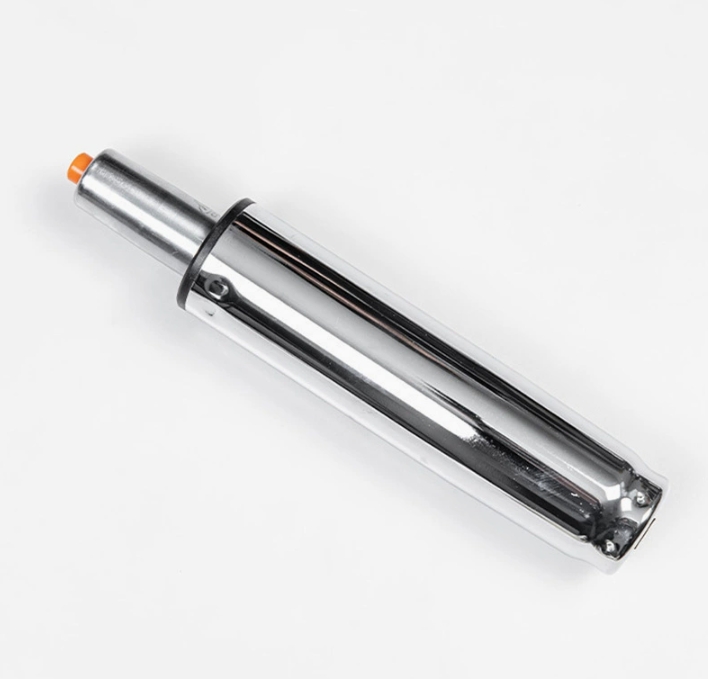
- gas lift
- expected static and dynamic load
- frequency of use
For high-load or commercial applications, the mechanism should be selected and validated according to the complete assembly and the applicable requirements.
How can mechanism development cost be controlled for small quantities?
Not every project requires a completely new mechanism.
Costs can potentially be reduced by:
- reusing an existing mechanism architecture;
- modifying only the mounting interface;
- reusing standard springs and hardware;
- adapting an existing lever design;
- using a prototype before committing to production tooling;
- grouping similar chair models into one mechanism family.
The most economical solution depends on quantity, design complexity, tooling requirements, and expected future demand.
How can one mechanism platform support multiple chair models?
Instead of creating a separate mechanism for every chair, the models can first be grouped by:
- mounting pattern
- seat geometry
- functional requirements
- tilt range
- load class
- lever configuration
A common mechanism platform can then support multiple interface variants where practical.
This can reduce:
- engineering repetition
- tooling duplication
- inventory
- future development time
The goal is controlled compatibility, not unlimited compatibility.
How should a large refurbishment or OEM program be developed?
For a larger project, the development process can be structured as:
Model Identification
→ Interface Classification
→ Mechanism Selection
→ CNC Mounting Mapping
→ Prototype
→ Fit & Functional Validation
→ Production
→ Reusable Specification
This creates a repeatable mechanism platform instead of solving every future order as a completely new project.
How can total mechanism cost be minimized?
The purchase price is only one part of the cost.
The complete economic picture may include:
Mechanism Cost
Engineering
Prototype
Tooling
Installation Labor
Rework
Inventory
Warranty / Replacement
Future Development
A lower-priced mechanism can become more expensive if it creates additional modification, installation, or warranty work.
The better comparison is:
Total project cost and risk over the intended service period.
Solution Guidance for Refurbishment & OEM Projects
Standard Replacement
Use an existing mechanism when the chair interface and functional requirements already match.
Modified Interface
Use an existing mechanism with an engineered mounting modification when the difference is primarily geometric.
Adapter Solution
Use an intermediate interface when it provides a lower-cost and more reusable solution.
Custom Mechanism Configuration
Use this route when the required function, geometry, or loading cannot be achieved through existing configurations.
Mechanism Family
For multiple chair models or a recurring OEM program, create a small family of validated configurations rather than developing each model independently.
The Principle Behind the Solution
The objective is not to sell one specific tilt mechanism.
It is to identify the most practical path between the existing chair, the required function, and the available manufacturing options.
The solution may be:
- a standard mechanism
- a modified mechanism
- an adapter
- a custom mounting interface
- a customized mechanism configuration
- or, where appropriate, a different restoration strategy
We provide the engineering options and the information needed to evaluate them.
The final selection depends on the chair population, quantity, budget, functional requirements, expected usage, and refurbishment or OEM objectives.