Introduction: The Double-Edged Sword of China’s Office Chair Supply Chain
In the global office furniture supply chain, China — especially Foshan and Anji, the world’s two core manufacturing hubs — is an unavoidable powerhouse. While “Made in China” offers unparalleled advantages in cost efficiency and manufacturing craftsmanship, for inexperienced procurement teams, cross-border e-commerce sellers, and B2B importers, low upfront prices often come with invisible, profit-crushing traps.
To help you avoid costly mistakes in your next order, we’ve conducted deep industry research to break down the 5 most fatal hidden risks of sourcing office chairs from China, along with an objective, actionable pitfall-avoidance checklist for every stage of your procurement journey.

Risk 1: Hidden Material Substitution – The #1 Industry Tactic
This is the most prevalent practice in China’s office chair sector. Your pre-production samples may be flawless, but mass production orders often see material downgrades in areas invisible to the naked eye, which directly destroy product lifespan and safety.
The Most Common Material Downgrades
- Recycled Plastic vs. Virgin PP Material: Many low-priced chairs use recycled plastic for core load-bearing components. While the appearance is nearly identical, recycled plastic has drastically lower fatigue resistance and load-bearing capacity, with an extremely high risk of brittle cracking and sudden failure.
- Mesh Tension Failure: Inferior mesh will lose tension and sag within 6 months, completely eliminating any claimed “ergonomic support” and leading to user back pain and returns.
- Low-Density Foam Collapse: A thick-looking seat cushion may use recycled foam with a density below 25kg/m³, which will permanently collapse and deform in less than 3 months.
Pitfall-Avoidance Action Plan
- Explicitly mandate “No recycled materials allowed” in your formal purchase contract, with clear penalty clauses for non-compliance.
- Require suppliers to provide third-party lab test reports for core materials, including mesh tensile strength, plastic raw material certification, and foam density test data.
- Conduct random material inspections of mass production batches before shipment, not just pre-production samples.
Risk 2: Safety Certification Shell Game – Life-Threatening & Brand-Ruining
The gas lift (pneumatic cylinder) is the core safety component of an office chair. Poor-quality gas lifts are not just a quality issue — they can cause catastrophic failure, leading to serious injury, irreversible brand reputation damage, and costly product liability lawsuits.
Many suppliers claim their products meet BIFMA X5.1 or EN1335 standards, but in reality, only a single component has passing certification, not the entire chair. The gap between low industry standards and international safety requirements is stark:
| Component | Unregulated Industry Low Standard | International Standard (Class 3/4) |
|---|---|---|
| Gas Lift Wall Thickness | < 1.2mm | ≥ 1.5mm (Class 3) / ≥ 2.0mm (Class 4) |
| 5-Star Base Load Rating | 500kg Static Load Only | 1136kg Impact Test (BIFMA Mandatory) |
| Mechanism Cycle Testing | <10,000 Cycles | ≥120,000 Cycles (BIFMA Durability Standard) |
Pitfall-Avoidance Action Plan
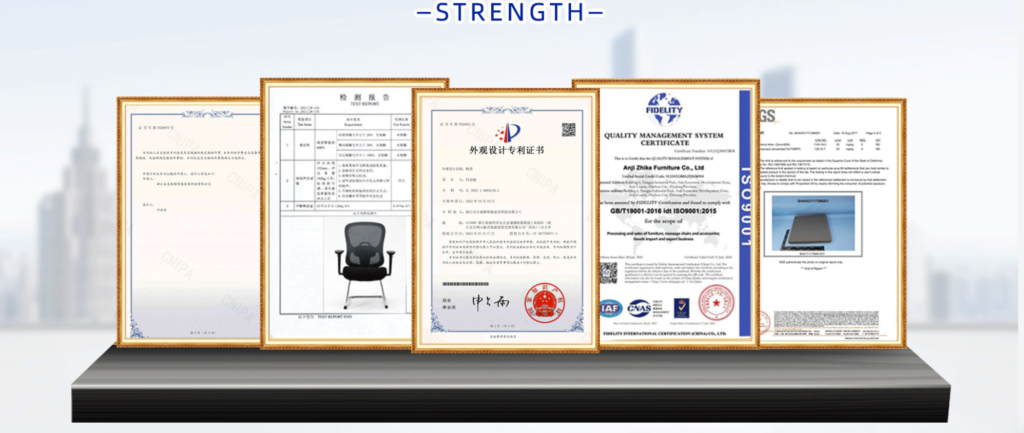
- Always verify the steel stamp on the gas lift itself, ensuring it has clear SGS/TÜV certification marks and explicit Class 3 or Class 4 rating.
- Require full-chair BIFMA/EN1335 test reports, not just individual component certificates.
- If a supplier’s full-chair price is 30% below the market average, safety component downgrades are almost guaranteed — treat this as a critical red flag.
Risk 3: Fake Ergonomic Claims – Marketing Hype vs. Real Support
“Ergonomic” has become the most overused marketing buzzword among Chinese office chair suppliers. The harsh reality is: adding a headrest does not make a chair ergonomic. The most common misleading claims include:
- Non-Adjustable Lumbar Support: Every user has a unique spinal curve; a fixed lumbar pad often does more harm than good, forcing the spine into an unnatural position.
- Missing Synchro-Tilt Mechanism: Cheap chairs use a 1:1 linked backrest and seat movement. When reclining, this lifts the user’s thighs, cuts off leg circulation, and creates spinal strain — the opposite of ergonomic design.
- Superficial Adjustments: Many “12-way adjustable” chairs only offer trivial, non-functional adjustments, with no control over the core elements that impact spinal health (seat depth, lumbar support position, tilt tension).
Pitfall-Avoidance Action Plan
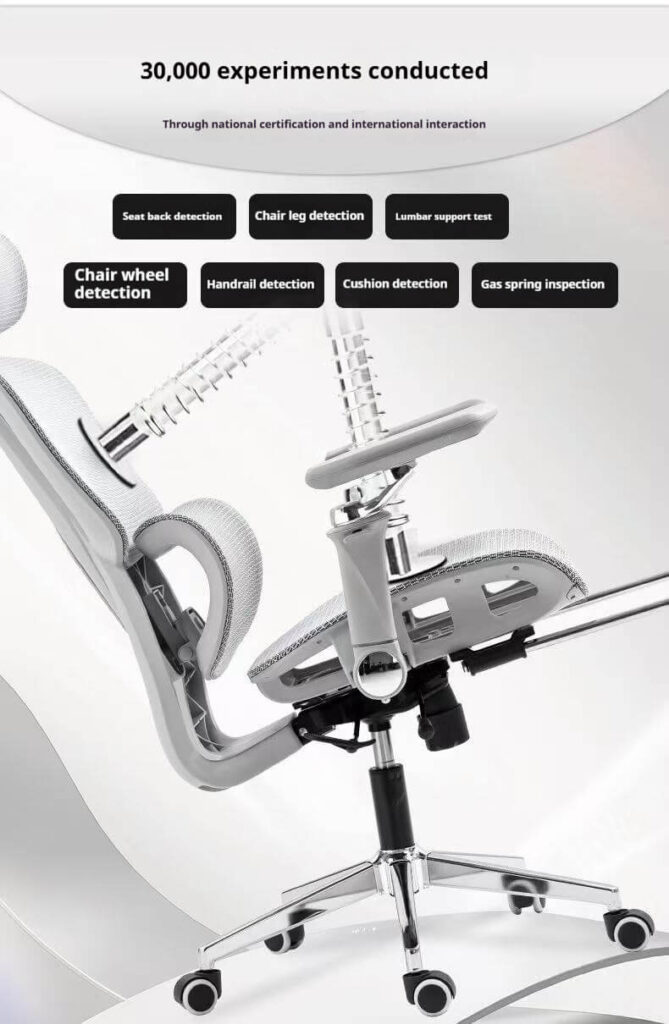
- Prioritize the functional chassis mechanism, which typically accounts for over 20% of a high-quality chair’s total cost.
- Explicitly ask if the chassis supports multi-position tilt locking and user weight-based tilt tension adjustment.
- Require anthropometric data to prove the chair’s adjustment range accommodates the 5th to 95th percentile of user body types in your target market.
Risk 4: Hidden Logistics Costs – Volumetric Weight & Poor KD Design
Office chairs are large, bulky items. If you overlook the Knocked Down (KD) disassembly design in the early sourcing stage, your international shipping costs could end up higher than the cost of the chair itself.
The two costliest oversights are:
- Low Container Utilization: Many manufacturers use semi-knocked-down designs to save assembly time, which wastes massive amounts of container space, drastically increasing your per-unit shipping cost.
- Shipping Damage: Packaging with fewer than 5 layers of corrugated cardboard, or insufficient internal cushioning, will lead to scratched 5-star bases, torn mesh, or broken components upon arrival — resulting in returns, refunds, and lost inventory.
Pitfall-Avoidance Action Plan
- Mandate that suppliers provide a Loading Quantity Optimization Plan before order confirmation, including exact container loading capacity for full KD designs.
- Require packaging that passes ISTA 1A/3A drop test standards, non-negotiable for cross-border e-commerce sellers and long-haul ocean shipping.
- Lock in packaging specifications and KD design details in your purchase contract to avoid last-minute changes that inflate your logistics costs.
Risk 5: After-Sales Ghosting & Hidden Compliance Risks
The biggest fear of sourcing from China is the “one-and-done transaction”. Once the final payment is settled, communication costs for quality disputes can skyrocket, and many suppliers disappear entirely when issues arise.
The two most damaging pitfalls here are:
- Warranty Loopholes: A claimed “5-year warranty” often only covers non-wearable structural parts, excludes common failure points, or requires you to ship defective parts back to China at exorbitant international shipping costs.
- Regulatory Non-Compliance: For the US market, this includes California TB117-2013 fire safety standards; for the EU, REACH chemical regulations and CE marking. If a factory cannot provide authentic, verifiable compliance documents, your shipment risks being detained at customs, destroyed, or hit with massive fines.
Pitfall-Avoidance Action Plan
- Conduct a formal factory audit before placing a bulk order, specifically verifying if they have an in-house quality control lab and dedicated after-sales support team for international clients.
- Stipulate a 2-3% free spare parts ratio in your contract, to cover shipping damage and minor repairs without costly international shipments.
- Require all mandatory market compliance documents upfront, before production starts, and verify their authenticity with the issuing certification bodies.
Conclusion: Office Chair Procurement Is About Buying Certainty, Not Just Low Prices
In a fiercely competitive market, low upfront prices may be tempting, but long-term brand credibility and low return rates are the true drivers of sustainable profitability.
Choosing a supplier that transparently discusses cost structures, willingly provides detailed third-party test reports, and optimizes packaging for your shipping needs is far more valuable than chasing the factory with the lowest quote. The cheapest chair on the quote will almost always be the most expensive one for your business in the long run.
Need Help With Your Office Chair Sourcing?
Are you struggling to find reliable, compliant office chair suppliers in China? We can provide professional supplier screening recommendations, industry benchmark pricing references, and a full BIFMA-compliant procurement audit checklist tailored to your target market.