In corporate financial management, office chairs are often mischaracterized as low-value expendable assets on the balance sheet. However, research from the Cornell University Ergonomics Research Group (CUErgo) shows that optimizing workplace ergonomic design can increase employee productivity by 17.5%.
Choosing office chairs for your team is, in essence, the management of your enterprise’s health risk exposure and output efficiency. This guide combines international standards and clinical medical evidence to provide you with an objective, actionable decision-making framework for corporate procurement.
1. Authoritative Evidence: Why Choosing the Right Office Chair Is Mission-Critical for Your Business
To ensure the scientific rigor of your procurement decisions, we reference findings from leading global authorities on workplace safety and ergonomics:
- Occupational Safety and Health Administration (OSHA): Confirms that musculoskeletal disorders (MSDs) caused by improper sitting account for 33% of workers’ compensation claim expenditures in the United States.
- Mayo Clinic: Highlights that prolonged sitting increases the risk of metabolic syndrome, while chairs with dynamic support can effectively reduce intervertebral disc pressure.
- Leading Industry Expertise: Internationally renowned ergonomics expert Dr. Alan Hedge emphasizes that an ideal office chair must support dynamic sitting, rather than rigid, fixed support.

2. 5 Core Dimensions for Screening Corporate Office Chairs
Aligned with the BIFMA G1-2013 Ergonomics Guideline (the global gold standard for office seating), a qualified procurement specification must include the following non-negotiable elements:
2.1 Dynamic Lumbar Support
- Scientific Rationale: The spine maintains its natural S-curve when seated. Inadequate support leads to excessive pressure on the L4 and L5 intervertebral discs, the most common source of chronic lower back pain in office workers.
- Procurement Standard: The lumbar support must offer both height and depth adjustability, with elastic responsiveness to ensure it remains fully aligned with the spine when the user reclines or leans forward.
2.2 Seat Pan Biomechanics
- Seat Depth Adjustment: This feature is non-negotiable. Per the ISO 9241-5 ergonomic standard, there must be a 2-3 finger gap between the front edge of the seat pan and the user’s popliteal fossa (back of the knee) to prevent venous compression and reduced leg circulation.
- Material Density: We recommend high-resilience foam with a density of $\ge 45\text{ kg/m}^3$, or high-tension breathable mesh with proven tension retention.
2.3 The Necessity of 4D Armrests
- Core Functionality: Armrests must support 4-way adjustability: height, depth, width, and rotational angle.
- Business Purpose: Designed to eliminate static load on the levator scapulae muscle, and prevent common office-related conditions including carpal tunnel syndrome and cervical spondylosis.
2.4 The Mechanism Chassis
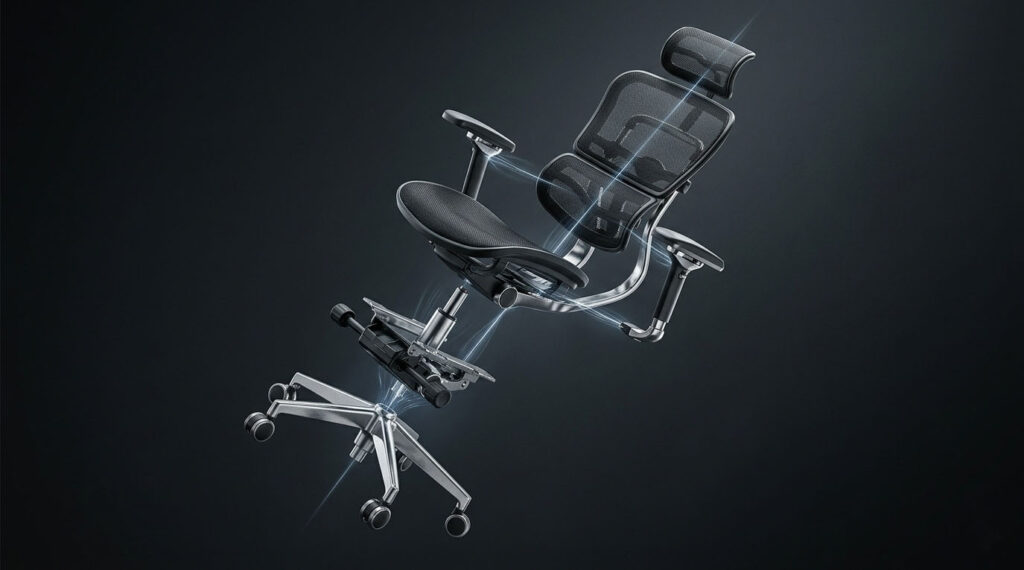
- Synchro-Tilt Mechanism: This is the defining line between a low-cost disposable chair and a professional ergonomic chair. The backrest and seat pan should recline at a 2:1 ratio — the optimal proportion to maintain the user’s eye level and open torso alignment during movement.
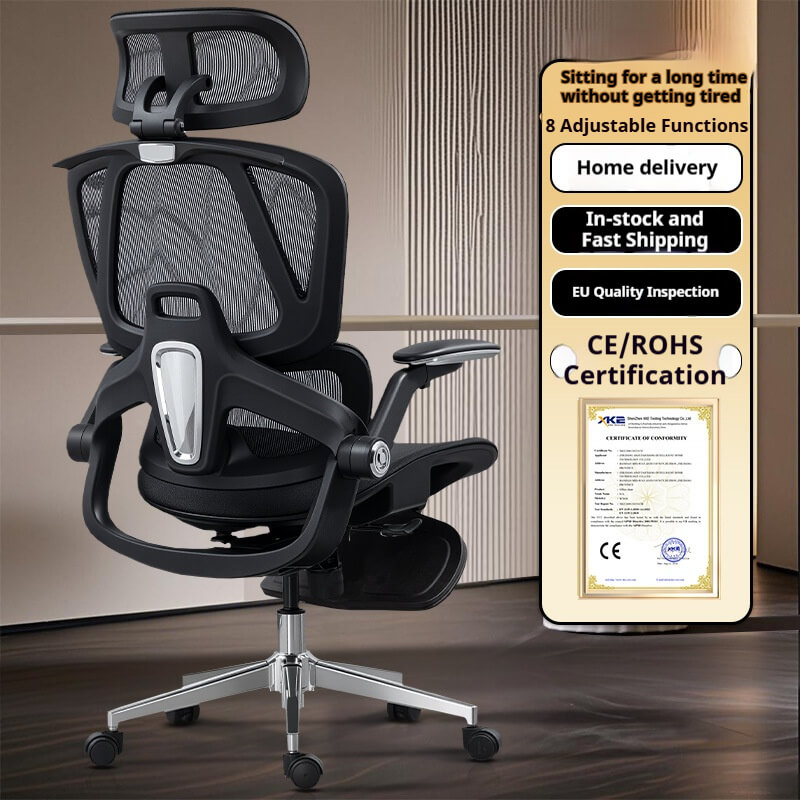
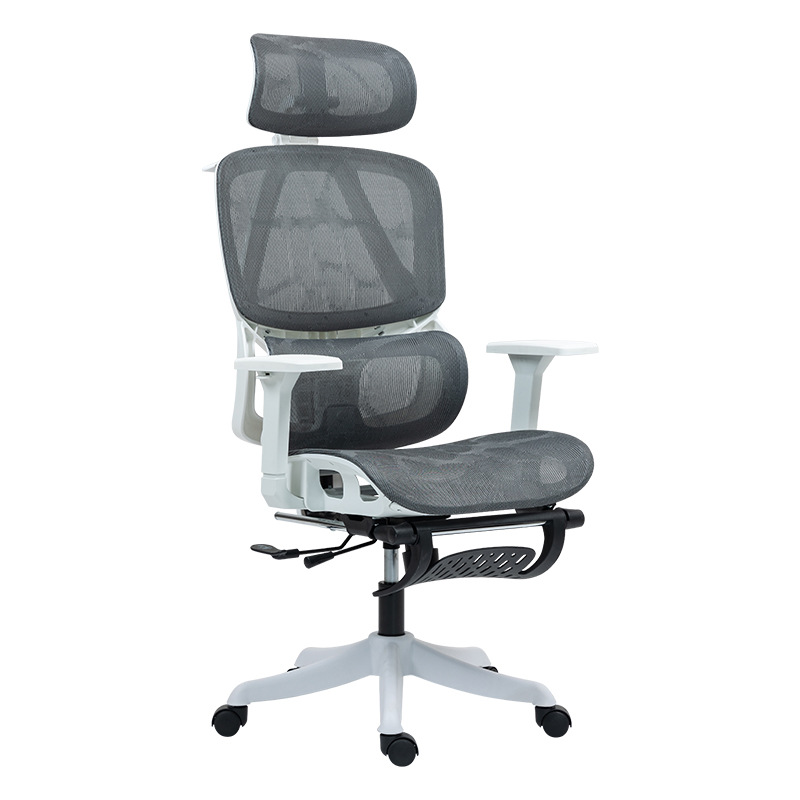
Innovative Standard: Premium enterprise models combine an 8D biaxial headrest, fish-pattern matrix mesh, movable seat depth, and a 135° deep recline to deliver 9 distinct design innovations for a top-tier sitting experience.
3. Financial Perspective: ROI Analysis of Ergonomic Office Chairs
We can calculate the economic value of investing in high-performance ergonomic chairs with a finance-team-approved formula:

Real-World Example
Assume an employee has an annual salary of $100,000. Even a conservative 5% improvement in productivity creates an additional $5,000 in annual value for the business. By contrast, a $500 high-end ergonomic chair with a 10-year service life has an annual depreciation cost of just $50.
4. Pitfall-Avoidance Guide: Common Mistakes in B2B Procurement
- Myth 1: A single unified model works for everyone.
- Fact: Employee heights range from 150 cm to 190 cm. Ensure the chair’s gas lift is Class 4 rated, with a height adjustment range that covers the 5th to 95th percentile of user body types.
- Myth 2: A long warranty term is all that matters.
- Fact: Many manufacturers promise a 10-year warranty, but only cover the frame — wearable components like mesh and gas lifts are often only warrantied for 2 years. Always request the full, detailed Warranty Policy before finalizing any order.
Procurement Target: Look for models featuring adaptive lumbar support, 9D multi-link armrests, authentic DuPont mesh, and a gravity-sensing self-adjusting chassis—delivering premium comfort at a practical cost.

5. Deep-Dive FAQ: Expanded Engineering & Clinical Architecture for Procurement Teams
Q1: Should we choose mesh chairs or foam-cushioned chairs for multi-department deployments?
The optimal choice depends on your workplace environment, thermal management, and job functions.
- High-Tension Mesh: Offers exceptional breathability, making it ideal for hot climates or facilities with zone-controlled HVAC systems. It prevents heat accumulation at the ischial tuberosities. However, ensure it utilizes premium elastomeric polymers (e.g., DuPont yarn matrix) to prevent long-term tension degradation and sagging.
- High-Density Cold-Cured Foam: Delivers superior pressure distribution across the gluteal muscles. It is better suited for roles requiring prolonged periods of deep, focused work (e.g., developers or financial analysts). Procurement must specify a density threshold ($\ge 45\text{ kg/m}^3$) to prevent permanent deformation over a 5-to-10-year life cycle.
Q2: Is BIFMA certification mandatory for all office chairs we procure, and what are the liability implications?
Certification from the Business and Institutional Furniture Manufacturers Association (BIFMA) is not just a quality marker; it is a critical legal and financial safeguard for enterprise-level procurement.
- BIFMA X5.1 Compliance: Requires the seating infrastructure to pass rigorous testing, including a 120,000-cycle backrest durability test and drop tests simulating extreme dynamic loads.
- Risk Mitigation: Deploying non-BIFMA compliant furniture exposes an enterprise to substantial civil liabilities and workers’ compensation claims if a structural failure (such as a gas lift explosion or base fracturing) occurs on-site.
Q3: How do we technicalize the integration of ergonomic office chairs with the growing trend of standing desks?
Office chairs must be selected to complement, not compete with, height-adjustable standing desks.
- The Sitting-Standing Biomechanical Model: Clinical data indicates that permanent standing introduces adverse cardiovascular risks, such as varicose veins and lower extremity edema, while permanent sitting causes spinal compression. The optimal workplace cadence is a 3:1 alternating ratio (e.g., 45 minutes of sitting followed by 15 minutes of standing).
- Integration Requirement: The procured chairs must possess a precise, smooth pneumatic travel range (Class 4 cylinder) to easily transition down when the desk lowers, ensuring the user can instantly find their exact ergonomic neutral position without interrupting their workflow.
Q4: What is the specific mechanical difference between a basic tilting chassis and a weight-sensing synchronous chassis?
This structural difference represents the primary cost driver and safety variable in office seating engineering.
- Basic Tilting/Center-Tilt Chassis: Tends to lift the user’s feet off the ground when reclining, causing pressure on the under-thigh blood vessels and altering the visual focal line relative to the monitor.
- Weight-Sensing Synchronous Chassis: Automatically calibrates the recline resistance based on the user’s body weight without manual knob adjustments. By maintaining a strict 2:1 or 3:1 angular displacement ratio between the backrest and the seat pan, it keeps the user’s feet flat on the floor, stabilizes the center of gravity, and preserves a consistent visual axis toward the screen throughout the entire range of motion.
Q5: How do international standards like EN 1335 differ from BIFMA, and which should global procurement prioritize?
Both are highly rigorous, but they approach structural compliance from slightly different geographic and anthropometric angles.
- EN 1335 (European Standard): Places an extraordinary emphasis on dimensional adjustability to accommodate a diverse European workforce, classifying chairs into Types A, B, and C based on their range of adjustment. It enforces strict safety parameters against sharp edges and entrapment hazards.
- ANSI/BIFMA (American Standard): Places heavier emphasis on raw load capacity and extreme structural durability testing to withstand higher weight thresholds (typically up to 400 lbs for specific tests).
- Global Strategy: For multinational enterprises, the optimal procurement blueprint is to specify dual-certified (BIFMA + EN 1335) seating assets to guarantee universal regulatory compliance and uniform ergonomic equity across all regional offices.
6. Conclusion: View Office Furniture Through a Strategic Lens
Choosing office chairs for your team is a long-term investment in your company’s most critical asset: your people. A workplace aligned with EN 1335 or BIFMA standards not only reduces hidden human capital costs for your business, but also significantly enhances your employer brand image.
References & Sources
- Cornell University: Ergonomic Seating Guide for Office Workers (Dr. Alan Hedge)
- BIFMA International: BIFMA G1-2013 Ergonomics Guideline
- ISO: ISO 9241-5: Ergonomic requirements for office work with visual display terminals
- OSHA: Workplace Musculoskeletal Disorders Guidelines
Need Customized Support for Your Procurement Project?
- Would you like a customized Ergonomic Seating Configuration & Budget Breakdown tailored to your office layout and team needs?
- Or, would you prefer a curated Top 5 Global/Domestic B2B Office Chair Brand Comparison Matrix to streamline your vendor shortlisting?