Abstract
With the global popularization of digital office work, sedentary behavior has become the leading trigger of chronic musculoskeletal disorders (MSDs). This white paper explores the mechanical alterations of human anatomy under prolonged static loads from a clinical perspective. It provides a systematic pain-relief and posture-optimization framework based on advanced biomechanical research and peer-reviewed medical evidence.
1. The Anatomical Crisis Under Static Load: Why Sitting Causes Pain
The evolutionary architecture of the human spine is optimized for dynamic movement rather than prolonged static axial loading. When an individual transitions from a standing position to a seated posture, the pelvis undergoes a posterior rotation. This pelvic tilt flattens or reverses the natural sagittal curvature of the lumbar spine, transferring the mechanical load from the stabilizing musculature to passive structural tissues.
1.1 Intervertebral Disc Pressure Analysis
According to the seminal intradiscal pressure measurements pioneered by Nachemson et al., structural loading varies drastically by posture. When the body is in a relaxed, forward-leaning seated position, the compressive force exerted on the L3 (third lumbar vertebra) intervertebral disc escalates to $185\%$ of the baseline pressure recorded during upright standing. This hyper-loading accelerates disc degeneration, nucleus pulposus displacement, and annular tearing.
1.2 Tissue Ischemia and Metabolic Accumulation
Research from the National Institute for Occupational Safety and Health (NIOSH) demonstrates that prolonged static postures trigger localized tissue ischemia (restricted blood flow). When intramuscular pressure exceeds capillary perfusion pressure, blood circulation is severely restricted. This impedes the delivery of oxygen and nutrients while trapping metabolic waste products, such as lactic acid and inflammatory cytokines, within the myofascial tissues, inducing non-specific lower back pain.
2. Neutral Spine: The Gold Standard Based on Biomechanics
The core objective of pain-free sitting is the maintenance of a Neutral Spine—the precise spatial orientation where mechanical loads are distributed optimally across the vertebrae, facets, and intervertebral discs.
2.1 The Pelvis: The Cornerstone of the Kinetic Chain
In her foundational work Diagnosis and Treatment of Movement Impairment Syndromes, physical therapist Shirley Sahrmann establishes that pelvic alignment dictates the geometric positioning of the entire superior spinal column.
To achieve an optimal kinetic baseline, the bilateral ischial tuberosities must bear weight symmetrically. Seating must facilitate an anterior pelvic tilt of approximately $10^\circ \text{ to } 15^\circ$. This specific angulation preserves the lordotic curve of the lumbar region and prevents the structural collapsing of the thoracic segments.
2.2 The Cervical Spine: Leverage Principles to Counteract “Forward Head Posture”
In The Physiology of the Joints, Adalbert Kapandji dictates that for every $2.5\text{ cm}$ of anterior cervical displacement relative to the gravity line, the load borne by the lower cervical spine escalates by approximately $4.5\text{ kg}$.
To eliminate this mechanical disadvantage, the earlobe must align vertically with the acromion process. This alignment neutralizes the eccentric contraction load imposed on the trapezius and levator scapulae muscles, resolving tension-type cervicogenic headaches and upper cross syndrome.
3. Dynamic Relief Strategy: From “Fixed Support” to “Micro-Movement”
Clinical paradigms confirm that maintaining any single posture over an extended duration, regardless of its initial ergonomic accuracy, induces viscoelastic tissue creep and muscular fatigue.
3.1 The McKenzie Method and Nucleus Pulposus Migration
According to the Mechanical Diagnosis and Therapy (MDT) framework developed by Robin McKenzie, periodic directional extension shifts the internal hydrostatic pressure of the intervertebral discs. Performing targeted lumbar extension movements every 45 minutes safely drives the posteriorly displaced nucleus pulposus anteriorly, reversing the structural stress caused by persistent flexion.
3.2 The 20-8-2 Biomechanical Work Model
To Operationalize dynamic movement, global ergonomics expert Professor Alan Hedge at the Cornell University Ergonomics Laboratory (CUErgo) formulated the 20-8-2 organizational model. Within a 30-minute operational block, the sequence is broken down as follows:
- 20 Minutes: Sitting in a supported, neutral ergonomic posture.
- 8 Minutes: Standing utilizing an adjustable standing desk to alter hydrostatic loads.
- 2 Minutes: Dynamic movement, ambulation, or targeted active stretching to stimulate the musculoskeletal pump.
4. Engineering Metrics for Ergonomic Equipment Selection
When evaluating corporate or personal seating infrastructure, procurement specifications must satisfy the safety and structural criteria set forth by ANSI/BIFMA G1-2013 and ISO 9241-5.
| Structural Component | Engineering Specification | Biomechanical & Clinical Rationale |
| Lumbar Support Height | Adjustable range matching the L3–L5 vertebrae. | Supports the apex of lumbar lordosis, reducing multifidus muscle fatigue. |
| Seat Pan Depth | $5\text{ cm} \pm 2\text{ cm}$ clearance from the popliteal fossa. | Prevents mechanical compression of the popliteal artery and reduces deep vein thrombosis (DVT) risks. |
| Armrest Width | Inter-armrest adjustment matching biacromial diameter. | Mitigates static loading on the rotator cuff and upper trapezius muscle groups. |
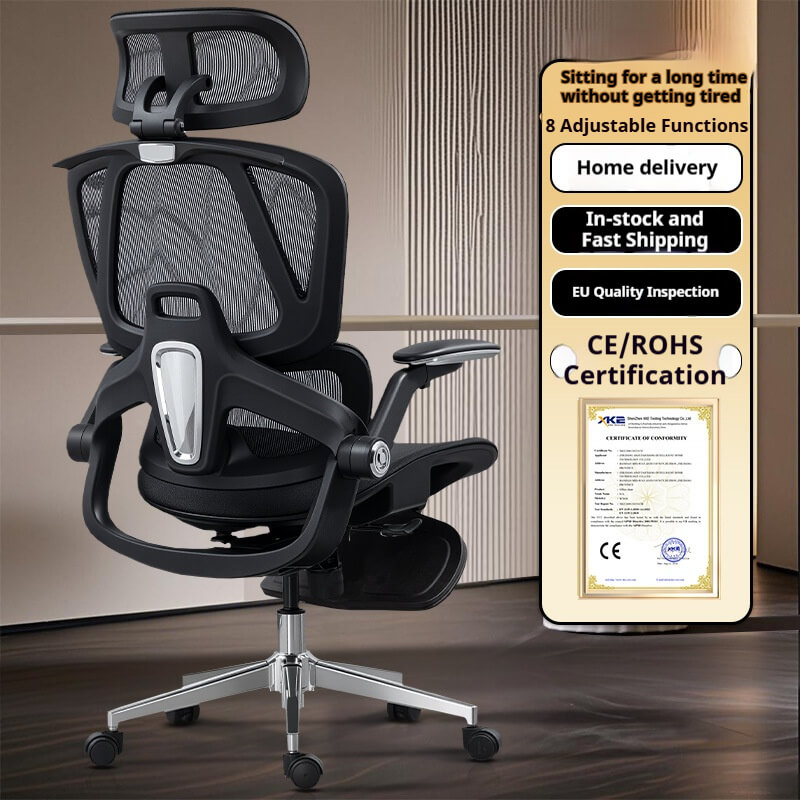
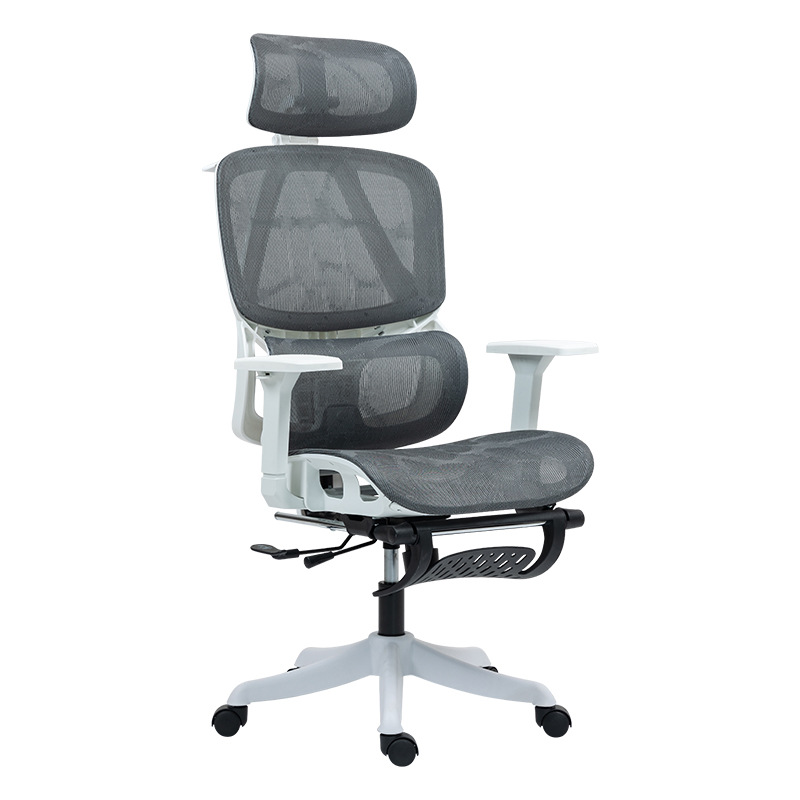
Advanced Mechanical Note: High-tier ergonomic chairs integrate an 8D multi-axis bi-directional headrest, advanced elastomeric dragon-pattern mesh matrix, and a synchronous chassis allowing up to $145^\circ$ of recline linked with a synchronized seat-pan glide. These features maximize pressure redistribution during rest phases.
5. Comprehensive FAQ: Deep-Dive Biomechanical & Clinical Interpretations
Q1: Why do I experience acute lower back pain even when consciously forcing myself to sit completely upright with a straight spine?
This occurs because an overly rigid “military-style” sitting posture forces the erector spinae, multifidus, and quadratus lumborum muscles into sustained, high-intensity isometric contractions. This continuous muscular exertion restricts local tissue perfusion, resulting in rapid metabolic fatigue and ischemic pain. True pain-free sitting relies on externalizing load bearing to an engineered chair backrest that supports natural spinal curves, allowing the core and paraspinal musculature to remain in a low-tonus, relaxed state.
Q2: What are the distinct physiological mechanisms behind why a lumbar roll provides pain relief?
Electromyographic (EMG) assessments published in the Journal of Physical Therapy Science confirm that an anatomically mapped lumbar roll decreases the active firing rates of the paraspinal muscles. By physically filling the structural void between the chair seat and the lumbar lordosis, the roll acts as a passive mechanical prop. This transfers structural weight away from vulnerable muscular attachments and distributes forces across the posterior bony structures of the vertebrae, effectively preventing muscular spasms.
Q3: When prolonged sitting causes gluteal numbness and tingling down the leg, is it an indicator of disk herniation or localized nerve compression?
While a herniated disc compressing a nerve root can cause these symptoms, localized gluteal numbness is frequently caused by Piriformis Syndrome or direct ischial compression. As documented by the Cleveland Clinic, prolonged sitting on inadequate cushioning compresses the sciatic nerve as it passes beneath or through the piriformis muscle. If the seat pan lacks proper pressure-distribution mechanics, it can trap the nerve against the pelvic bone. To differentiate this from disc-related sciatica, look for localized gluteal tenderness and a lack of radiating pain when performing a straight-leg raise while lying down.
Q4: How does the choice between a synchronous recline mechanism and a traditional center-tilt mechanism affect spinal loading?
A traditional center-tilt mechanism pivots from a fixed central axis, which lifts the user’s feet off the ground during recline. This increases pressure on the posterior thighs and disrupts the visual alignment with a monitor.
Conversely, a synchronous recline mechanism utilizes a multi-axis chassis that reclines the backrest and tilts the seat pan simultaneously at a coordinated ratio (typically $2:1$ or $3:1$). This design ensures that as the user reclines, their feet remain flat on the floor, their center of gravity stays stable, and the lumbar support maintains its exact anatomical positioning relative to the L3-L5 vertebrae throughout the entire movement.
Q5: What specific material property differences dictate whether high-density foam or elastomeric mesh is superior for chronic pain mitigation?
The choice depends on the specific type of pain and user anatomy. High-density, cold-cured foam ($\ge 45\text{ kg/m}^3$) provides superior pelvic stability and uniform pressure distribution across the ischial tuberosities. This makes it ideal for individuals prone to sacral pressure sores or piriformis irritation.
Conversely, elastomeric mesh provides excellent ventilation and point-elasticity, which prevents localized heat retention that can exacerbate neurogenic pain. However, mesh must be woven with high-tensile polymers to prevent sagging over time; a sagging mesh seat tilts the pelvis posteriorly, flattening the lumbar spine and triggering the exact mechanical loading pattern that causes chronic back pain.
6. Conclusion
Alleviating sedentary pain does not rely on a single device, but a systematic framework combining posture awareness, biomechanical alignment, and intermittent dynamic adjustment. By adhering to the neutral spine principle and using evidence-based ergonomic support, you can effectively reverse the degenerative pressure on the spine caused by static load.
References & Authoritative Sources
- Nachemson, A. L. (1981). The Lumbar Spine: An Orthopaedic Challenge. Spine.
- McGill, S. M. (2015). Low Back Disorders: Evidence-Based Prevention and Rehabilitation. Human Kinetics.
- Sahrmann, S. (2002). Diagnosis and Treatment of Movement Impairment Syndromes. Mosby.
- BIFMA (Business and Institutional Furniture Manufacturers Association). (2013). G1-2013 Ergonomics Guideline.
- Cornell University Ergonomics Laboratory (CUErgo). Sitting and Standing at Work.
- Mayo Clinic. (2024). Office Ergonomics: Your How-to Guide.
Need Personalized Spine Health Support?
- Would you like a customized Office Spine Health Self-Screening Checklist for yourself or your team?
- Or would you like to dive deeper into biomechanical exercise prescriptions for specific symptoms (such as cervical spondylosis)?