
Replace Worn Swivels Without Rebuilding the Entire Seat
When a seating swivel wears out, replacing the complete seat or chair is not always necessary.
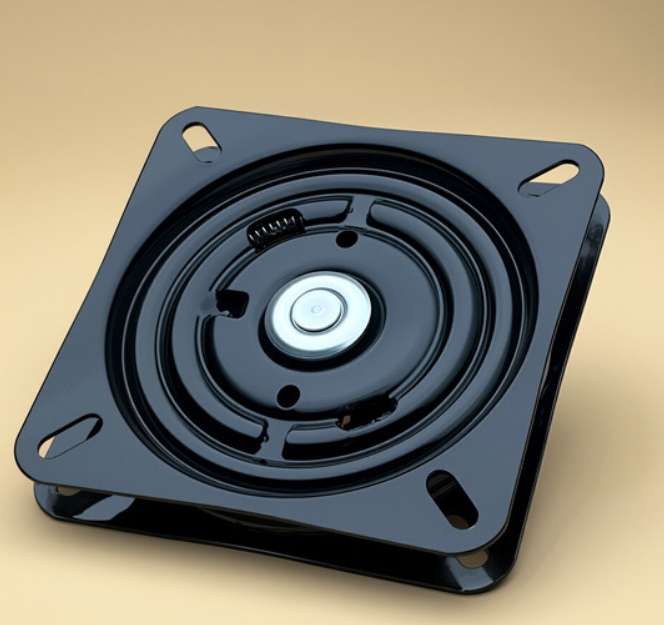
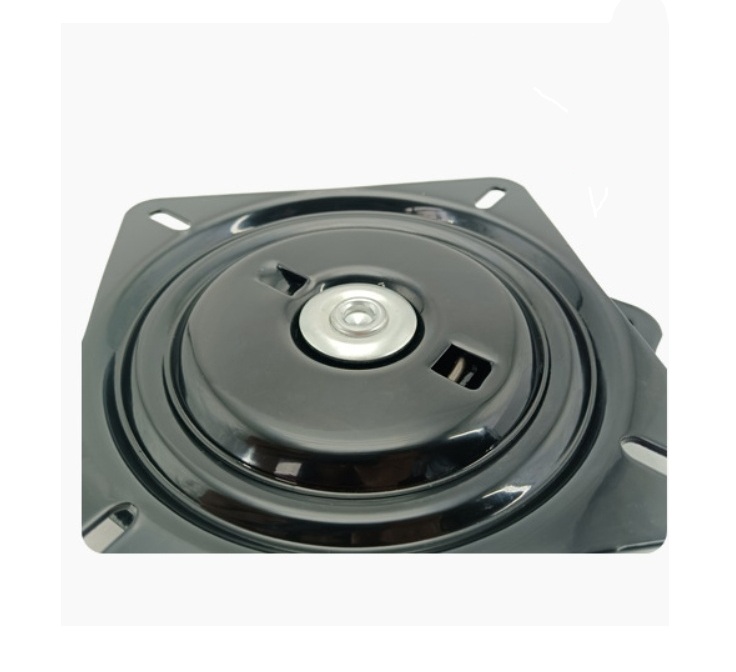
This heavy-duty memory swivel mechanism is designed for commercial seating refurbishment, replacement, and high-use applications where controlled rotation, automatic return, and a robust mounting interface are required.
Typical applications include:
- bar and counter seating
- casino and gaming seating
- marine seating
- hospitality seating
- commercial stools
- specialty OEM seating
The objective is to restore the required function while minimizing unnecessary changes to the existing seat structure.
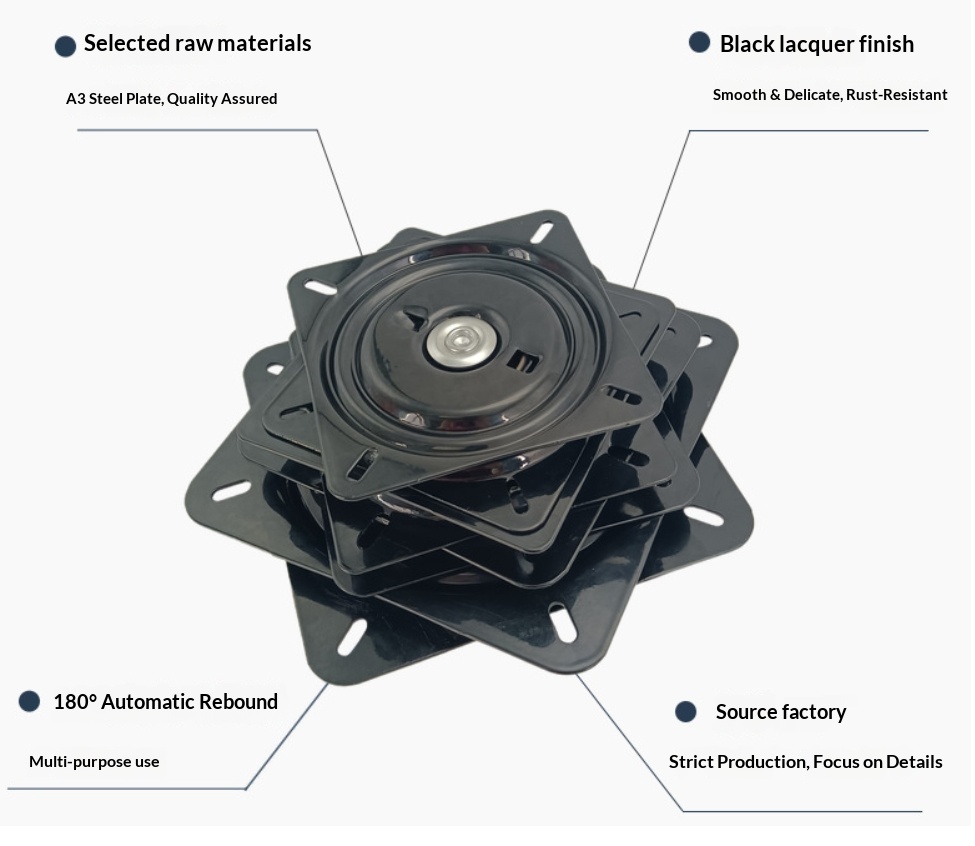
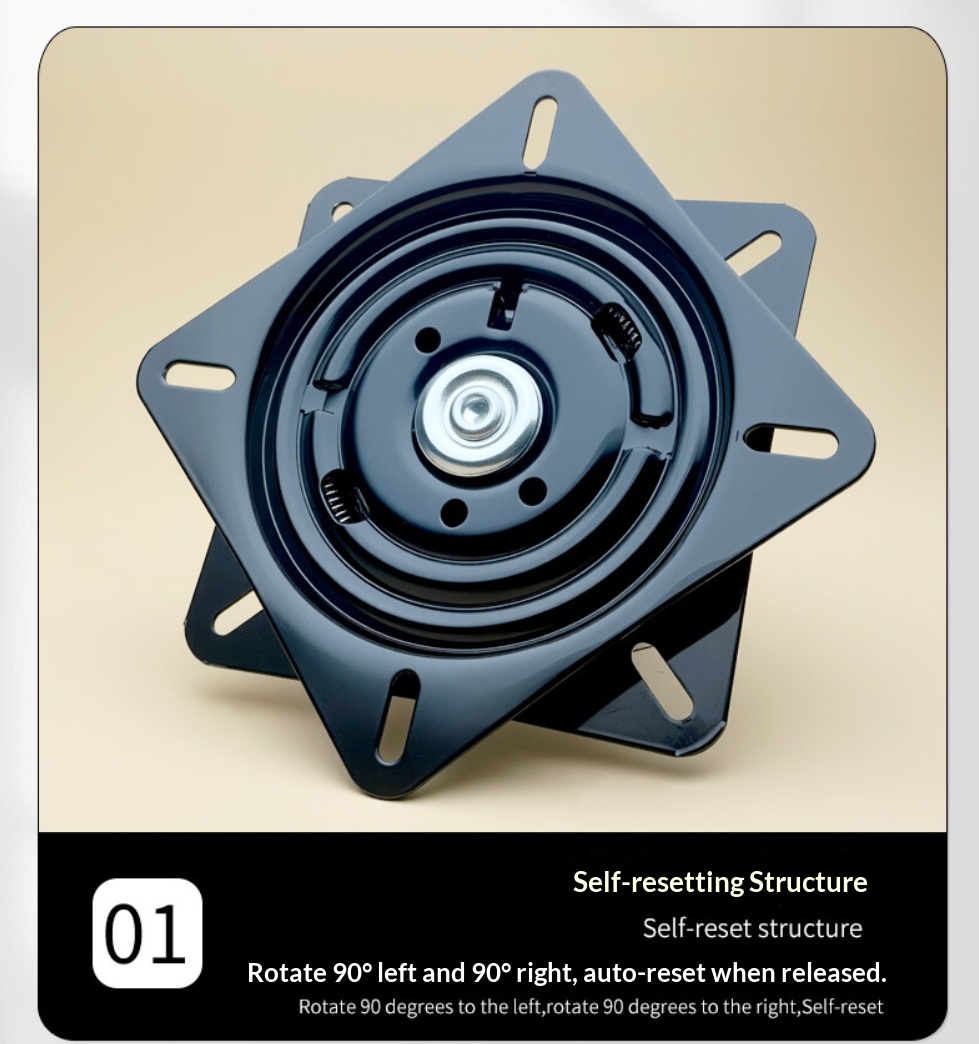
180° Auto-Return Self-Centering
The integrated torsion-spring mechanism provides controlled rotational movement with an automatic return toward the center position after the seat is vacated.
This can help:
- keep seating aligned
- maintain a cleaner appearance
- reduce manual repositioning
- improve consistency across rows of stools or chairs
- support hospitality and commercial seating layouts
The actual return behavior depends on the spring configuration, seat geometry, load distribution, and installation conditions.
Slotted Mounting for Compatibility Adjustment
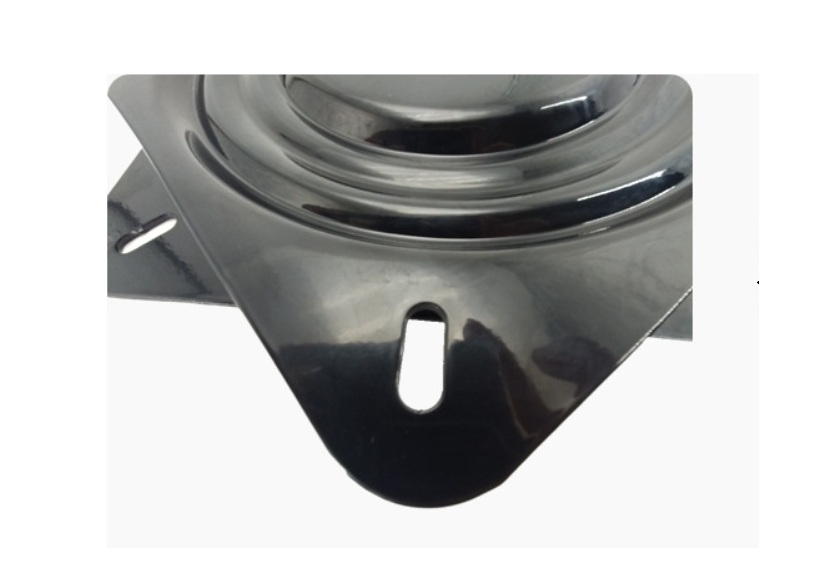
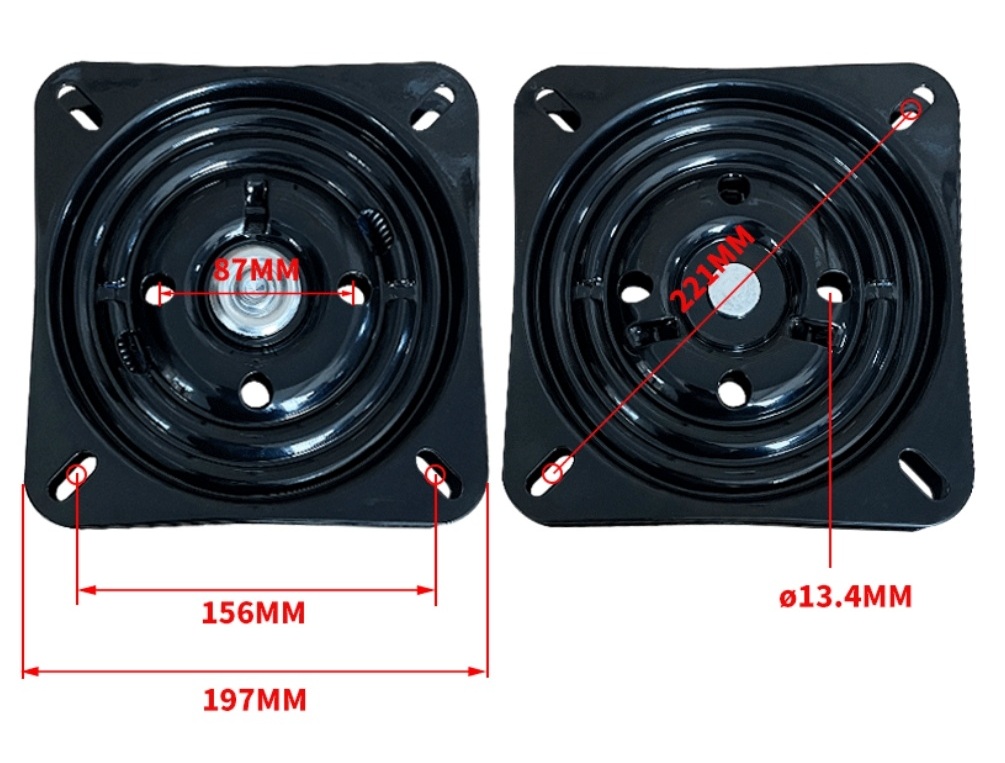
Refurbishment projects often involve existing mounting patterns that are close to, but not perfectly aligned with, an available replacement swivel.
The elongated mounting slots provide controlled positional adjustment within the designed range.
This can help accommodate reasonable variations in:
- mounting-hole location
- existing frame dimensions
- manufacturing tolerance
- replacement-component geometry
The swivel should still be matched to the original mounting pattern, fastener requirements, and available clearance before installation.
Centered and Offset Axis Options
Different seats do not always load directly through the geometric center of the swivel.
Available configurations can include:
Centered Axis
For applications where the rotational axis is approximately centered relative to the seat load.
Offset / Eccentric Axis
For selected applications where the seat geometry or mounting arrangement requires an offset rotational center.
The correct axis configuration depends on:
- seat geometry
- center of gravity
- mounting position
- available clearance
- intended rotation behavior
Heavy-Duty Steel Construction
The swivel uses a reinforced steel structure designed for demanding commercial seating applications.
A rated load capacity exceeding 200 kg (440+ lb) is available for the specified configuration.
Actual allowable loading should be evaluated together with:
- mounting structure
- fasteners
- seat frame
- loading direction
- dynamic loading
- installation conditions
A load rating for the swivel itself does not automatically establish the capacity of the complete seating assembly.
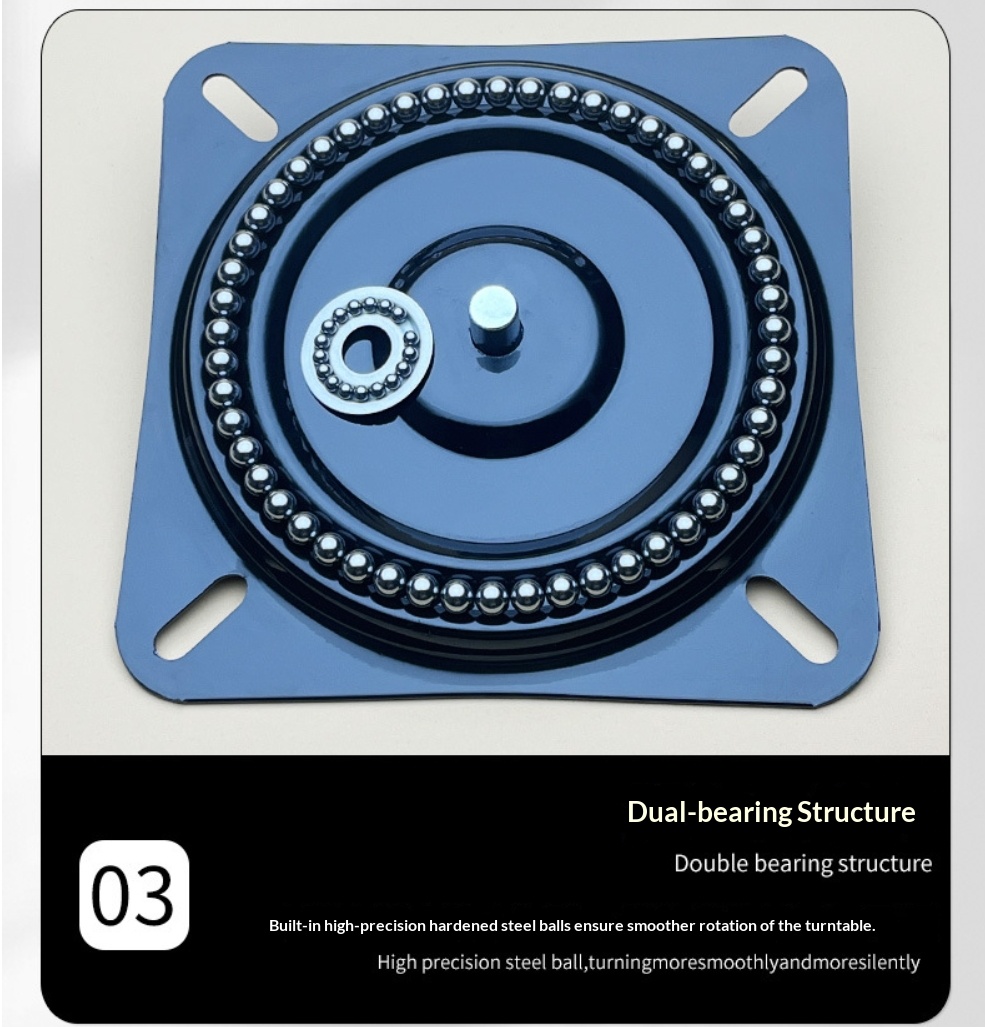
Dual-Track Bearing Structure
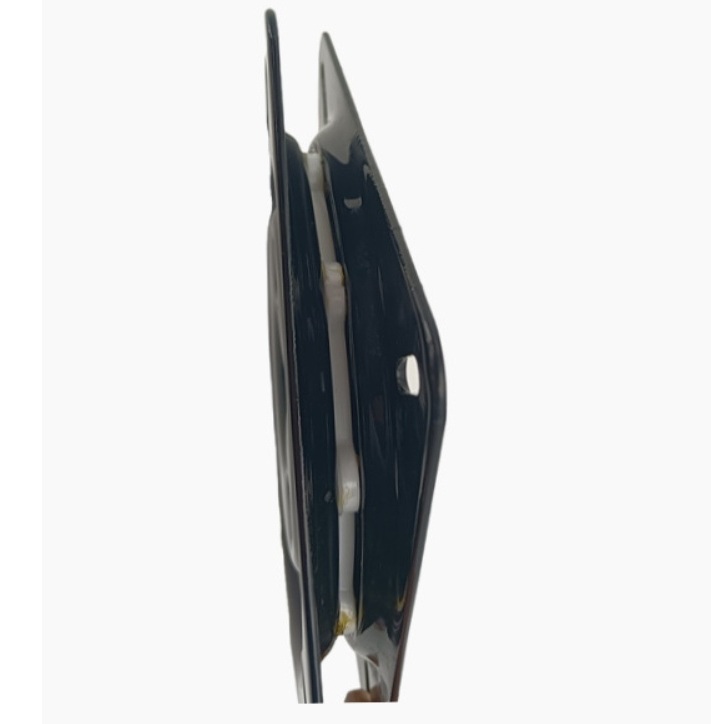
Instead of relying on a simple single-track swivel arrangement, the mechanism uses a reinforced dual-track bearing structure with hardened steel rolling elements.
The objective is to provide:
- smoother rotational movement
- improved load distribution
- greater resistance to localized shear loads
- reduced risk of grinding or binding under demanding use
The final operating performance depends on the complete installation and applied loading conditions.
Protection for Demanding Environments
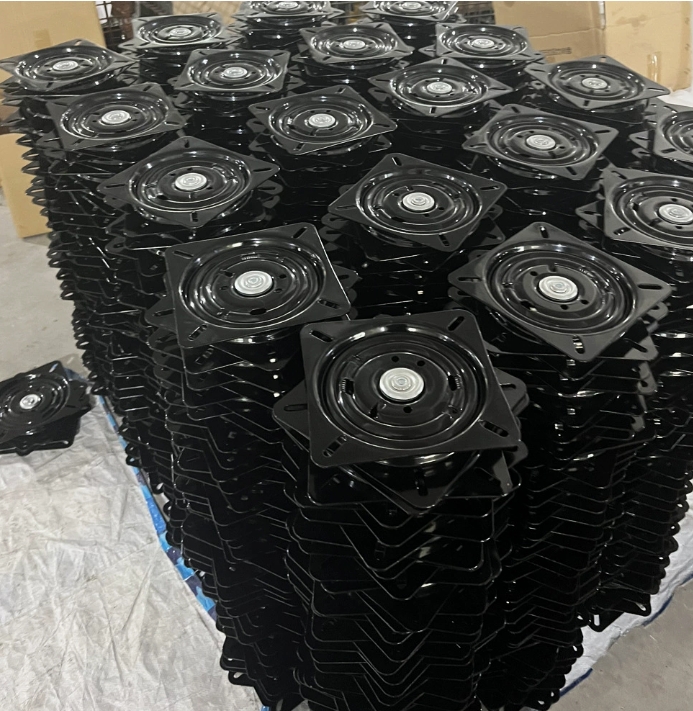
For marine, hospitality, and other demanding applications, the steel components can use a combination of E-coating and powder coating for additional corrosion and surface protection.
This can be useful where the component is exposed to:
- coastal humidity
- salt-laden air
- commercial cleaning
- frequent handling
- elevated moisture
The appropriate finish should still be selected according to the actual operating environment and maintenance requirements.
FAQ — Swivel Compatibility, Rotation & Refurbishment
What should be checked before replacing a seating swivel?
A swivel should be evaluated as a complete interface rather than as a simple rotating plate.
Important factors can include:
- mounting-hole pattern
- hole spacing
- hole diameter
- mounting reference
- plate dimensions
- seat geometry
- rotational axis
- seat angle
- overall height
- surrounding clearance
- expected static and dynamic load
- environmental conditions
A swivel can physically attach while still producing an unsuitable rotational position, height, or clearance condition.
Can one swivel fit every bar stool or commercial chair?
No single swivel should be assumed to fit every seating application.
Different seats can use different:
- mounting patterns
- axis positions
- seat angles
- frame geometries
- load conditions
A better approach is to identify the common mounting and operating requirements and then select the appropriate swivel configuration.
Where necessary, an adapter or modified mounting solution can be considered.
What is the advantage of a 180° auto-return swivel?
A memory swivel is designed to return toward a defined center position after the seat is released.
This can be useful where:
- chairs need to remain aligned
- visual consistency is important
- seats are positioned around bars or gaming tables
- manual repositioning would add labor
- repeated use requires predictable orientation
The actual return position and spring behavior should be verified against the intended seat geometry and installation.
When should a centered-axis swivel be used?
A centered-axis configuration may be appropriate when the rotational center is approximately aligned with the intended seating load and mounting geometry.
It can provide a straightforward solution where:
- the seat is relatively symmetrical
- the mounting pattern supports a central axis
- no special ergonomic offset is required
The appropriate configuration should be determined from the actual seat and frame geometry.
When is an offset or eccentric axis useful?
An offset axis may be useful when the intended rotational center is not located at the geometric center of the seat.
Possible reasons include:
- deep seat geometry
- asymmetric mounting
- ergonomic requirements
- clearance constraints
- existing frame geometry
The correct offset should be established from the actual application rather than selected simply because a larger offset is available.
Does the mounting slot make the swivel “universal”?
No.
Slots increase the range of mounting adjustment, but they do not eliminate the need to verify compatibility.
The complete installation should still be checked for:
- mounting range
- bolt engagement
- structural support
- edge distance
- clearance
- seat position
- rotational axis
The goal is practical compatibility within a defined design range, not unlimited compatibility.
What if the original swivel is discontinued?
Several solution paths may be available.
Direct Replacement
Use an existing swivel with compatible mounting and functional specifications.
Functionally Compatible Replacement
Select a replacement that reproduces the required:
- rotation
- return behavior
- axis position
- load capacity
- mounting interface
without copying every detail of the original.
Adapter or Modified Mounting Solution
Where the replacement interface differs from the existing seat frame, an adapter or mounting modification may be considered.
Customized Swivel Configuration
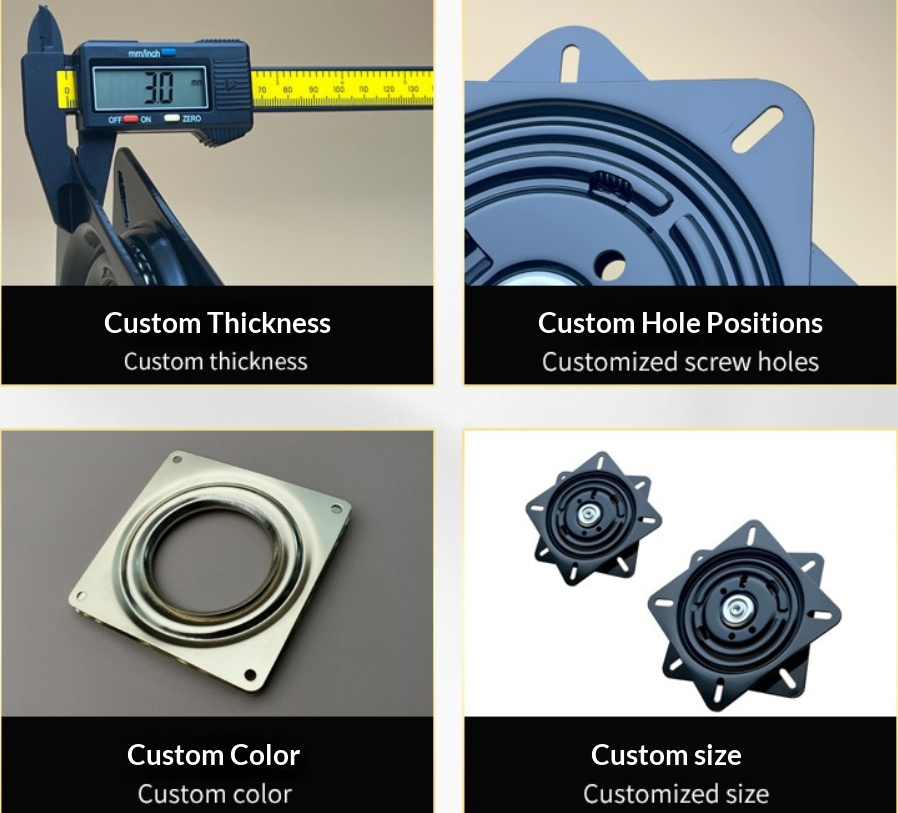
For repeated OEM or refurbishment demand, a customized axis, mounting pattern, angle, spring configuration, or finish may be developed.
The appropriate route depends on quantity, application, existing geometry, and total project cost.
How should swivel compatibility be verified on an older seat?
A practical verification process can include:
- Identify the original seat and swivel.
- Measure the mounting pattern.
- Record plate dimensions and hole locations.
- Determine the rotational axis.
- Check seat angle and overall height.
- Review surrounding clearance.
- Confirm expected loading.
- Evaluate environmental exposure.
- Install and test a sample.
- Validate rotational and return behavior before larger-volume deployment.
This is especially important when original drawings or specifications are unavailable.
What if the existing frame differs slightly from the nominal mounting dimensions?
Small dimensional differences can arise from:
- manufacturing tolerance
- previous repair
- frame deformation
- wear
- accumulated assembly variation
Possible approaches include:
- using the available slot adjustment
- modifying the mounting interface
- developing an adapter
- redesigning the mounting plate
The appropriate solution depends on the magnitude and direction of the variation.
The objective should be to solve the interface issue without creating a new structural weakness.
How can swivel development cost be controlled?
A new swivel does not always need a completely new design.
Depending on the application, existing elements may be reusable:
- bearing architecture
- spring mechanism
- plate geometry
- fasteners
- mounting concepts
- surface-finishing process
Engineering effort can then focus on the specific difference:
- mounting pattern
- axis location
- seat angle
- load requirement
- clearance
- spring behavior
For larger projects, grouping similar seat configurations before development can reduce repeated engineering and tooling costs.
Solution Guidance for Commercial Seating Projects
Small Repair or Replacement
A verified standard swivel may provide the simplest and lowest-cost route.
Discontinued Swivel
A functionally compatible replacement may avoid replacing an otherwise usable seat.
Mixed Seating Inventory
A compatibility map can be used to group seats by:
- mounting pattern
- axis
- seat angle
- load range
- swivel configuration
This can reduce unnecessary SKU expansion.
Large Refurbishment Program
A standardized swivel family, sample validation, and reusable compatibility data can provide a more repeatable procurement and refurbishment process.
OEM / B2B Custom Program
For recurring demand, the swivel can potentially be customized around:
- mounting pattern
- axis position
- seat pitch
- spring configuration
- load requirements
- finish
- environmental protection
Total Cost Matters More Than Swivel Price
For refurbishment and replacement projects, the swivel itself is only one part of the total cost.
The broader cost can include:
Component Cost
Shipping
Installation Labor
Rework
Compatibility Risk
Tooling / Development
Inventory
Future Replacement
A low-cost swivel that requires repeated modification or replacement may create a higher total cost than a more suitable configuration.
The better comparison is:
Total cost + reliability + compatibility + future reuse.
The Principle Behind the Solution
The objective is not to force every seating application into one universal swivel.
It is to identify the simplest configuration that satisfies the real mechanical and operational requirements.
The solution may be:
- a standard swivel
- a slotted configuration
- a centered-axis configuration
- an offset-axis configuration
- an adapter
- a customized mechanism
- or, where appropriate, a different refurbishment strategy
We provide the engineering options and the compatibility information needed to evaluate them.
The final choice depends on the project quantity, seat geometry, loading, operating environment, budget, and refurbishment objectives.