When an office chair breaks, replacing the entire chair is often the easiest answer—but it is not always the most economical one.
A failed caster, gas cylinder, armrest, seat mechanism, or chair base can make an otherwise valuable chair unusable. For older or discontinued models, the problem becomes more complicated: the original part may no longer be available, and a standard replacement may not fit.
This creates a much bigger question than simply finding a replacement part:
How do you determine the most economical way to recover the value of an office chair?
Sometimes the answer is a standard replacement part. Sometimes it is an adapter. Sometimes a component has to be reverse engineered and custom manufactured. And sometimes, replacing the entire chair is still the better decision.
The following FAQ examines the problem from the perspective of compatibility, repair, refurbishment, manufacturing, and total recovery cost.
1. What are the most common office chair replacement parts?
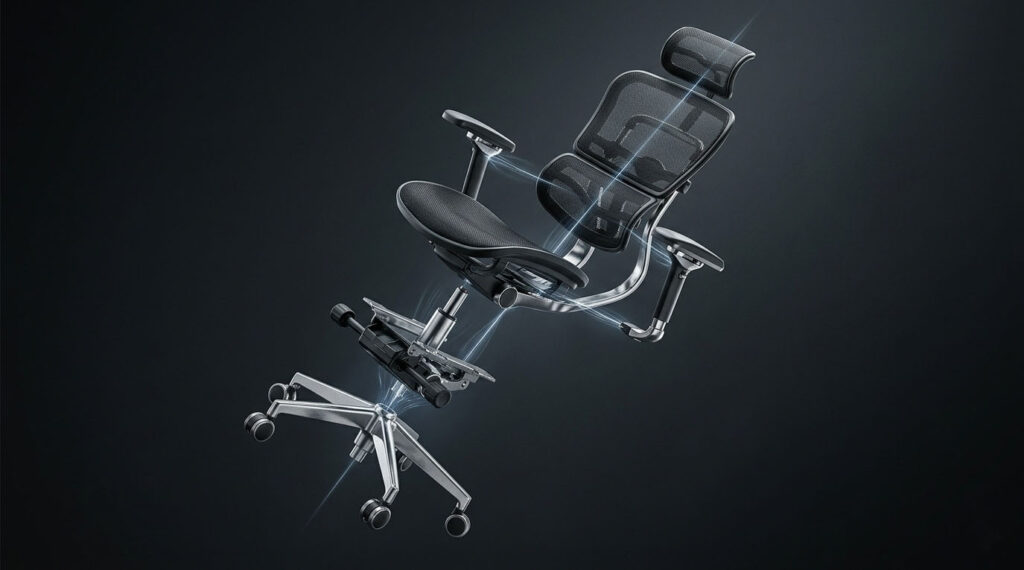
Common replacement parts include:
- Casters and wheels
- Gas cylinders
- Chair bases
- Seat mechanisms
- Tilt mechanisms
- Seat plates
- Armrests and arm pads
- Backrest components
- Lumbar support components
- Footrings
- Mounting hardware
Some of these parts are relatively standardized. Others are highly specific to a particular chair design or generation.
That distinction is important.
A replacement caster may be relatively easy to source. A discontinued seat mechanism with a unique mounting pattern may be a completely different problem.
2. Are office chair replacement parts universal?
No.
Some office chair components are designed around common dimensions and interfaces, which makes replacement relatively straightforward.
However, compatibility depends on much more than appearance.
Important factors can include:
- Mounting-hole spacing
- Shaft diameter
- Thread dimensions
- Overall dimensions
- Interface geometry
- Height
- Load capacity
- Attachment method
- Movement range
- Clearance
Two components may look almost identical and still be incompatible.
This is why choosing a replacement part based only on the chair’s brand or appearance can lead to expensive mistakes.
3. How do I identify the correct replacement part?
Start with the chair itself, not the product catalog.
Record the model, age, manufacturer, and any markings on the existing component.
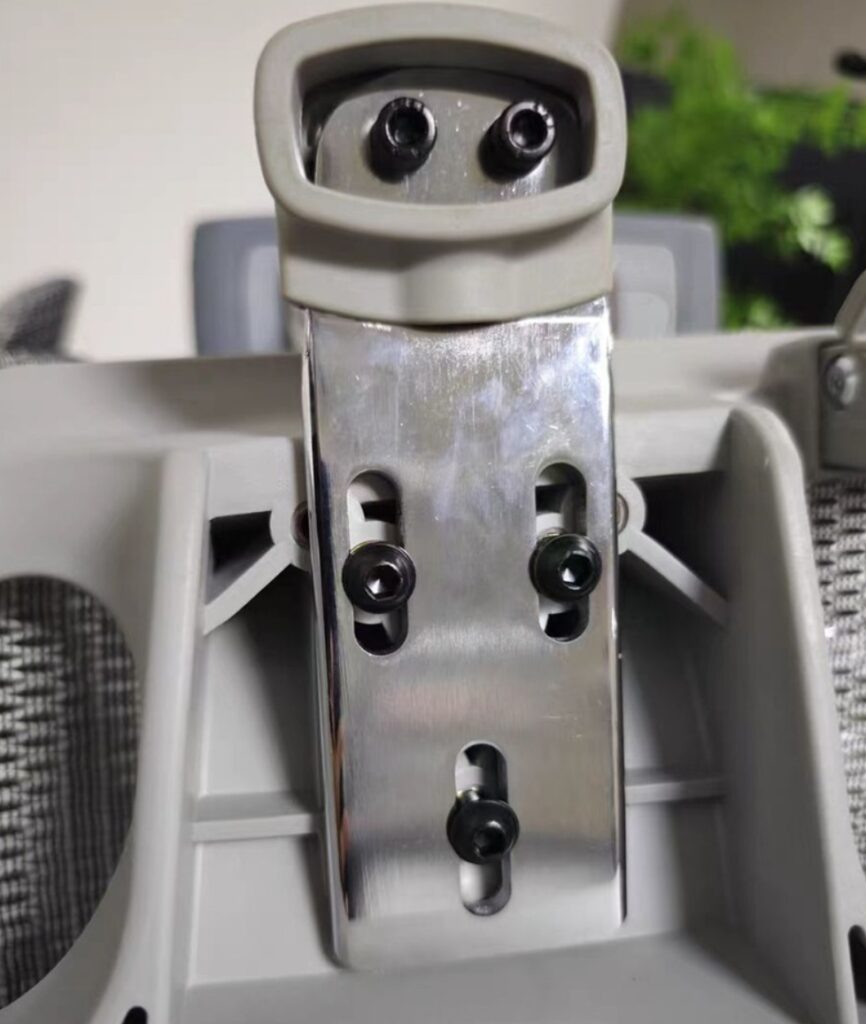
Then measure the actual interface.
Depending on the component, this may include:
- Hole spacing
- Hole diameter
- Shaft dimensions
- Component width and length
- Overall height
- Mounting pattern
- Connection points
- Thread specifications
Photographs are useful, but measurements are usually more important.
The most reliable replacement is not necessarily the part that looks most similar. It is the part that matches the mechanical interface and performs the required function.
4. What is the hardest office chair part to replace?
There is no single answer, but components that connect several systems are usually more difficult.
A chair base, for example, interacts with the:
- Gas cylinder
- Seat mechanism
- Casters
- Chair height
- Center of gravity
- Load distribution
- Floor contact
A seat mechanism can be even more demanding because it may determine how the seat attaches, tilts, reclines, and transfers load into the rest of the chair.
The smaller a component looks, the easier it is to underestimate its importance.
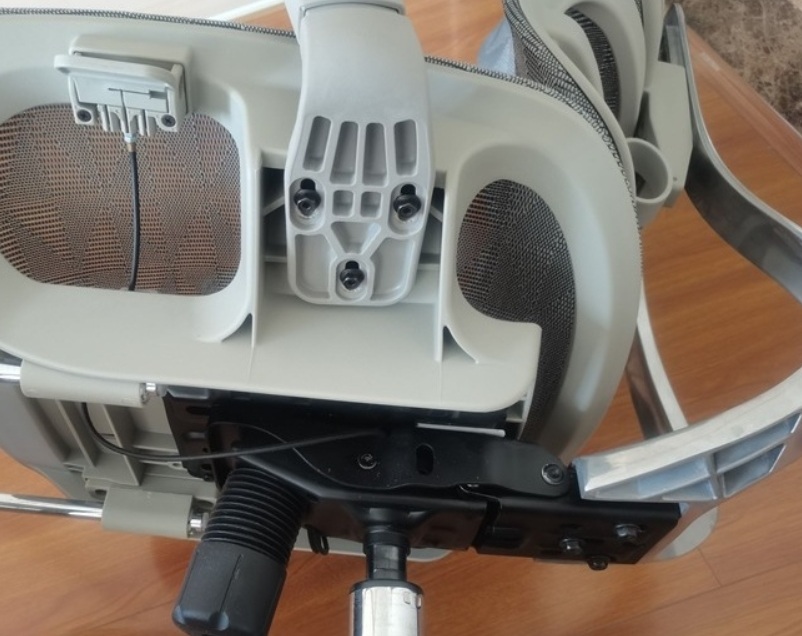
5. Can I replace only the broken component instead of the entire chair?
In many cases, yes.
A broken gas cylinder does not necessarily mean the chair is finished.
The same applies to a failed caster, armrest, mechanism, or base.
This is the fundamental reason replacement parts exist: a failure in one component does not automatically eliminate the value of the entire product.
For individual users, this can avoid unnecessary replacement.
For furniture dealers and refurbishers, the implications are much larger because one replacement component can determine whether an entire inventory item can be resold.
6. When is repairing an office chair better than replacing it?
Repair makes economic sense when the value recovered from the repair exceeds the total cost of recovery.
A simple way to think about it is:
Recovery Value – Total Recovery Cost = Economic Value of the Repair
Total recovery cost includes more than the price of the part.
It can include:
- Replacement parts
- Labor
- Shipping
- Disassembly
- Installation
- Inspection
- Cleaning
- Reupholstery
- Rework
- Warranty exposure
- Inventory time
A $30 replacement part is therefore not necessarily a $30 repair.
The real question is what the complete recovery process costs.
7. Why can an inexpensive replacement part become an expensive repair?
Because the part itself may be only one part of the process.
Consider a commercial refurbishment operation handling hundreds of chairs.
If a replacement part costs $25 but requires additional fitting, adjustment, and inspection, the labor associated with that part may become more expensive than the part itself.
At small quantities, the difference may be insignificant.
At 500 or 1,000 units, small inefficiencies become substantial costs.
This is why commercial refurbishment decisions should be based on total cost, not simply purchase price.
8. What happens when the original office chair part has been discontinued?
There are several possible paths.
First: Find remaining original inventory
This is usually the simplest solution if the part is still available.
Second: Find a compatible replacement
An aftermarket component may perform the same function if its interfaces and specifications are appropriate.
Third: Use an adapter
An adapter can bridge two incompatible interfaces.
Fourth: Reverse engineer the original component
The existing component can be measured and its critical geometry and interfaces reconstructed.
Fifth: Design a new component
If reproducing the original design is unnecessary or uneconomical, a new component can be designed around the required function.
The important point is that a discontinued original part does not automatically mean the chair has reached the end of its useful life.
9. What is an adapter plate used for?
An adapter plate exists to solve a compatibility problem.
If two components were never designed to connect to each other, an adapter can create a new interface between them.
This can be an extremely effective solution because it may require:
- Little development time
- Low tooling investment
- Small production quantities
- Minimal modification to existing components
For a small number of chairs, an adapter can often be the most economical answer.
But an adapter is not automatically the best solution for every situation.
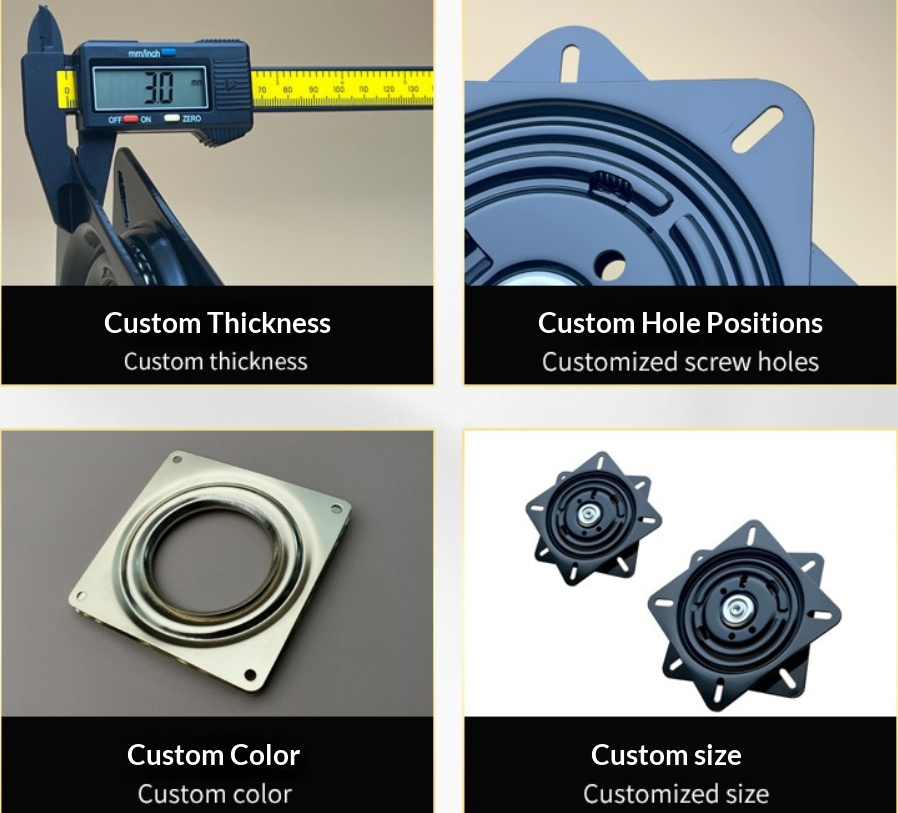
10. If an adapter works, why would anyone need a custom component?
Because making two components physically connect is only one part of the problem.
A solution also has to consider:
- Overall height
- Stability
- Load distribution
- Structural strength
- Clearance
- Appearance
- Assembly time
- Number of additional components
- Long-term reliability
An adapter adds another interface.
That can mean additional hardware, additional assembly, additional thickness, and additional opportunities for error.
For one chair, this may not matter.
For hundreds of chairs, it can become significant.
11. When does a custom office chair component make more sense than an adapter?
There is no universal threshold.
The answer depends on the relationship between:
Part cost +labor + assembly + rework + risk
and
the value recovered from the chair.
Suppose an adapter costs $40 and a custom component costs $100.
At first glance, the adapter appears to be the obvious choice.
But if the adapter requires additional machining, installation, adjustment, and inspection, its real cost may be considerably higher.
The custom component may then become economically attractive—not because it is technically more sophisticated, but because it produces a lower total recovery cost.
This is the critical distinction.
The cheapest component is not always the cheapest solution.
12. What is reverse engineering in office chair repair?
Reverse engineering is the process of determining how an existing component is designed and functions so that its geometry, interfaces, and required performance can be reproduced.
For a replacement component, the process may involve:
- Identifying the original function
- Measuring the existing component
- Identifying critical interfaces
- Establishing dimensional requirements
- Examining movement and load requirements
- Determining suitable materials
- Reconstructing the geometry
- Producing a prototype
- Testing fit
- Testing function
- Manufacturing the final component
The objective is not necessarily to reproduce every detail of the original part.
The objective is to reproduce the required function reliably and economically.
13. Does a custom replacement part have to be identical to the original?
No.
There are two very different objectives:
- Replication: reproduce the original component.
- Functional replacement: reproduce the required function.
If the original component is discontinued, a functional replacement may be more practical than an exact copy.
The new design may use a different manufacturing process, material, reinforcement method, or geometry while maintaining the necessary interfaces and performance.
However, any modification must be properly evaluated for fit, strength, stability, and intended use.
14. Why are discontinued parts particularly important to office furniture refurbishers?
Because refurbishers are not dealing with one chair at a time.
They are dealing with inventory.
Imagine a refurbisher acquires 1,000 office chairs.
Perhaps:
- 850 need ordinary refurbishment
- 100 need standard replacement parts
- 50 require unusual or discontinued components
Those final 50 chairs create a disproportionate problem.
The chairs may still have substantial value, but the missing component prevents them from reaching the resale market economically.
The issue is therefore not simply whether the chairs are broken.
The issue is whether the cost of recovering them is justified by the value they can generate.
15. Why does inventory volume change the replacement-parts decision?
Because small costs multiply.
If an additional process costs only $10 per chair:
- 10 chairs = $100
- 100 chairs = $1,000
- 500 chairs = $5,000
- 1,000 chairs = $10,000
The same $10 that looks insignificant on one chair can become a major operating expense across a large inventory.
This is why commercial refurbishment requires a different way of thinking about replacement parts.
The question is no longer:
“Can this chair be repaired?”
It becomes:
“Can this inventory be recovered profitably?”
16. How should a refurbisher decide whether a chair is worth repairing?
A practical evaluation can follow this sequence:
Step 1: Determine the expected recovered value
What can the chair realistically be sold for after refurbishment?
Step 2: Identify the failure
What exactly prevents the chair from being sold?
Step 3: Find the simplest solution
Can a standard part solve the problem?
Step 4: Evaluate compatibility
Will the replacement work without additional modification?
Step 5: Evaluate alternatives
Would an adapter, repair, reproduction, or custom component be more economical?
Step 6: Calculate total recovery cost
Include labor, shipping, processing, and risk.
Step 7: Compare the result with other options
Repair, sell as-is, part out, or scrap.
This prevents a common mistake: spending money simply because a repair is technically possible.
17. What is the difference between repairability and economic recoverability?
They are not the same.
A chair can be technically repairable but economically unrecoverable.
For example, if a chair is worth $200 after refurbishment but requires $250 to recover, the fact that it can technically be repaired does not make the repair sensible.
Conversely, a technically difficult repair can make economic sense if the recovered value is high enough.
This distinction is especially important for premium and commercial office chairs.
18. Why do high-value office chairs justify more complicated replacement solutions?
Because the economic margin can support more recovery work.
Consider two chairs:
- Chair A: Potential resale value after repair: $100. Maximum economically reasonable recovery cost: relatively low.
- Chair B: Potential resale value after repair: $600. A more sophisticated recovery process may be justified.
The same replacement solution can therefore be uneconomical for one chair and highly attractive for another.
The part does not determine the economics by itself.
The asset determines the economics.
19. Is a universal replacement part always the most economical choice?
No.
A universal component reduces sourcing complexity, but it does not guarantee the lowest total recovery cost.
A universal part may require:
- Additional hardware
- Modification
- Adapters
- Extra labor
- Adjustment
- Additional inspection
A purpose-built component may cost more to purchase but require less work to install.
Again, the correct comparison is not:
$30 versus $80.
It is:
Total cost of solution A versus total cost of solution B.
20. Why can a small replacement component determine whether an entire chair is profitable?
Because a chair is a system.
A small component may determine whether the chair can:
- Be assembled
- Function correctly
- Support the intended load
- Be safely used
- Pass inspection
- Be sold
The physical size of a component has little relationship to its economic importance.
A $10 component can sometimes determine whether a $500 chair becomes a saleable product or a source of spare parts.
21. What should a refurbisher do when no standard replacement part exists?
The most sensible approach is to move through solutions from simplest to most complex:
Standard replacement ——Compatible aftermarket part——Adapter——Repair or modification——Reverse engineering——Custom manufacturing——Parts recovery or scrap
This sequence matters.
There is no reason to commission a custom component when a $20 standard part solves the problem.
There is also no reason to repeatedly force an adapter onto a product when a properly designed replacement component would reduce total cost across hundreds of units.
The objective is not maximum engineering.
The objective is minimum economical recovery cost.
22. When should an office chair be scrapped instead of repaired?
When the expected recovered value is lower than the total recovery cost, and no alternative solution can change that equation.
For example:
- The frame is structurally damaged
- Several major components have failed
- Replacement components are excessively expensive
- Labor requirements are too high
- The model has little resale demand
- The finished chair cannot generate sufficient margin
At that point, continuing to repair the chair may destroy value rather than recover it.
Parting out the chair or recycling it may be the more rational decision.
23. What should businesses consider besides the price of a replacement part?
At minimum:
- Part cost
- Shipping
- Labor
- Installation time
- Machining
- Cleaning
- Inspection
- Rework
- Failure rate
- Warranty exposure
- Inventory holding time
- Expected resale value
For large refurbishment operations, there is another factor: throughput.
A solution that saves five minutes per chair can have enormous value when thousands of chairs are processed every year.
24. What does “compatibility” really mean?
Compatibility has at least three levels:
1. Physical compatibility
Does it fit?
2. Functional compatibility
Does it work correctly after installation?
3. Economic compatibility
Does using it make financial sense?
The first two are engineering questions.
The third is a business question.
A technically perfect replacement can still be the wrong choice if it costs more to install than the value it recovers.
25. Why is total cost more important than replacement-part price?
Because a replacement part is only one input into the recovery process.
Consider two options:
Option A
- Part: $35
- Additional labor: $30
- Modification: $15
- Inspection: $10Total: $90
Option B
- Part: $70
- Additional labor: $10
- Modification: $0
- Inspection: $5Total: $85
The more expensive part is actually the cheaper solution.
This is why replacement-parts decisions should be based on total recovery cost, not purchase price alone.
26. What is the real purpose of an office chair replacement part?
At the consumer level, the purpose is simple:
Replace something that has failed.
At the commercial level, the purpose is much larger:
Recover the useful and economic life of an existing asset.
That distinction matters.
A replacement part can prevent:
- Premature disposal
- Unnecessary replacement purchases
- Loss of inventory value
- Reduced resale value
- Unnecessary labor
- Unusable stock
The part is only the mechanism.
Value recovery is the objective.
27. Can custom manufacturing actually reduce costs?
Yes, but only under the right conditions.
Custom manufacturing tends to become more attractive when:
- The original component is unavailable
- Standard parts are incompatible
- Adapter solutions become complicated
- The chair has substantial residual value
- Multiple units require the same solution
- Installation labor is significant
- The replacement is likely to be needed repeatedly
It becomes less attractive when:
- Only one very low-value chair is involved
- A standard replacement works
- The tooling or engineering cost is excessive
- The recovered value is too low
Custom manufacturing is therefore not inherently expensive or economical.
Its value depends on the problem it solves.
28. Is reverse engineering always worth doing?
No.
Reverse engineering has its own cost.
It becomes attractive when the expected recovered value justifies the engineering effort.
A single $50 chair rarely justifies extensive engineering.
A discontinued component needed for hundreds of high-value chairs may be a completely different situation.
This is another example of why quantity and asset value matter as much as the part itself.
29. What is the best replacement strategy for a large office furniture inventory?
Treat the inventory as an economic system rather than a collection of individual chairs.
A practical classification might look like this:
- Category A (Ready for resale): Only cleaning or minor adjustment is required.
- Category B (Standard repair): Common replacement parts solve the problem.
- Category C (Special repair): The chair requires unusual components or an adapter.
- Category D (Engineering recovery): The chair requires reverse engineering or a custom component.
- Category E (Parts recovery): Repair is no longer economically justified.
This approach prevents valuable engineering resources from being wasted on low-value assets.

30. What is the most important question before ordering an office chair replacement part?
Not:
“How much does the part cost?”
The better question is:
“How much value will this part recover?”
Suppose an $80 component allows a $500 chair to return to saleable condition.
The $80 cost may be highly reasonable.
Now suppose a $20 component is required to restore a chair that can only be sold for $30 after extensive labor.
The $20 part may be economically wrong.
The same replacement component can therefore be a good investment in one situation and a bad investment in another.
31. What is the simplest way to calculate repair ROI?
A useful starting point is:
Recovery ROI = Recovered Value – Total Recovery Cost
Where recovered value is the realistic value of the chair after recovery, and total recovery cost includes all meaningful expenses associated with the process.
For larger operations, the calculation can be expanded to include:
- Labor efficiency
- Processing time
- Inventory carrying costs
- Failure rates
- Warranty costs
- Expected resale margin
The more valuable the inventory, the more important these factors become.
32. What should a business look for in a replacement-parts supplier?
A large catalog is useful, but it is not enough.
A serious commercial supplier should ideally be able to handle:
- Standard replacement: When the correct part already exists.
- Compatibility problems: When a common part does not fit.
- Discontinued components: When the original supplier no longer supports the product.
- Reverse engineering: When drawings and specifications are unavailable.
- Custom manufacturing: When a standard solution does not make economic sense.
- Consistent production: When the same solution is required across a large inventory.
The most valuable supplier is not necessarily the one with the largest catalog.
It may be the one that can answer:
“What do we do when the part you need no longer exists?”
33. What happens when the original part no longer exists?
The absence of an original part does not automatically determine the fate of the chair.
There are still several possible outcomes:
- Find it.
- Replace it.
- Adapt it.
- Repair it.
- Reproduce it.
- Redesign it.
- Or finally, retire the asset.
The correct answer depends on economics.
34. Why is the replacement-parts problem really an asset-recovery problem?
Because the part itself has little value outside the system it restores.
A chair component may cost $50.
But the reason someone buys that component is not because the component is worth $50 by itself.
It is because the component may allow an otherwise unusable asset to recover hundreds of dollars in value.
This changes the way replacement parts should be evaluated.
The real product is not always the component. The real product is the recovered value.
35. What is the ultimate decision when choosing between a standard part, an adapter, and a custom component?
Use the simplest solution that produces a reliable result at the lowest total recovery cost.
That usually means:
- Use a standard part when it fits.
- Use an adapter when it solves the compatibility problem economically.
- Use a custom component when repeated modification, poor fit, structural limitations, labor, or scale make the adapter solution less economical.
- Retire the asset when recovery no longer makes financial sense.
There is no universal winner.
The correct solution changes with:
- Chair value
- Quantity
- Part availability
- Labor
- Compatibility
- Manufacturing cost
- Reliability
- Resale value
36. What is the real lesson behind office chair replacement parts?
The most important lesson is simple:
A broken component does not necessarily mean a broken asset.
The decision should not begin with:
“Can I find the original part?”
It should begin with:
“What is the most economical way to restore the value and function of this asset?”
Sometimes that means a standard replacement.
Sometimes it means an aftermarket component.
Sometimes it means an adapter.
Sometimes it requires reverse engineering.
Sometimes it requires custom manufacturing.
And sometimes the correct decision is to stop spending money on the chair.
The difference between these outcomes is not determined by the part alone.
It is determined by compatibility, engineering, quantity, labor, reliability, remaining asset value, and ultimately return on investment.
That is why office chair replacement parts are more than a parts-sourcing problem.